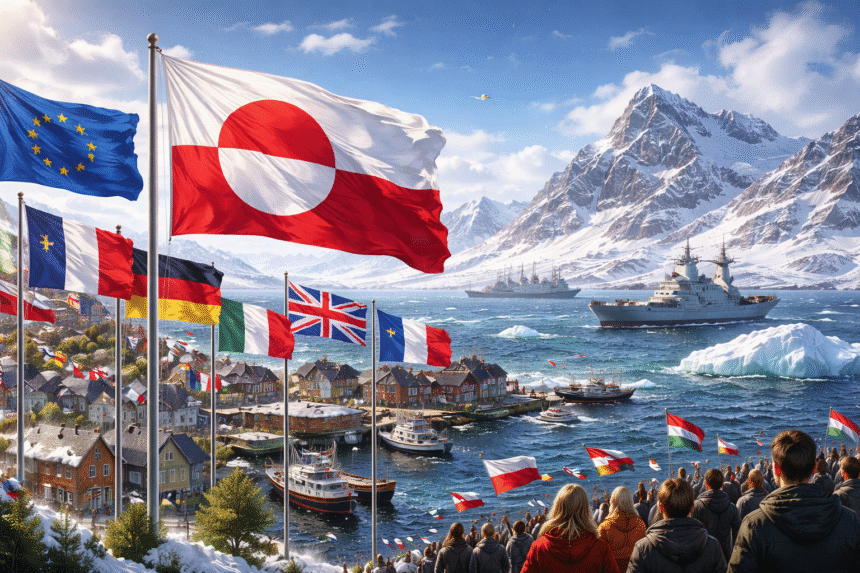
European leaders have issued a strong and unified message backing Greenland’s sovereignty and the right of its people to determine their own future, following renewed statements from U.S. President Donald Trump suggesting that the United States may seek control over the vast Arctic territory.
In a joint statement released on January 6, 2026, senior leaders from France, Germany, the United Kingdom, Italy, Spain, and Poland — alongside Danish Prime Minister Mette Frederiksen — emphasized that Greenland “belongs to its people,” and that decisions concerning its governance are solely matters for Danmark and Greenland to decide. They affirmed their commitment to international law, territorial integrity, and the inviolability of borders, calling for security in the Arctic to be pursued collectively and within existing alliances such as NATO.
Their statement came after a series of controversial remarks from President Trump and senior U.S. officials that reopened discussion within Washington about acquiring Greenland, including the possibility of using military force as an option to secure the territory — an idea that has alarmed European capitals. Trump’s team has framed Greenland’s strategic Arctic location as vital for U.S. national security and as a counter to perceived Russian and Chinese influence in the region.
European and Danish Reaction
Denmark, responsible for Greenland’s foreign policy and defense, has taken a firm stance against any attempt to undermine Greenland’s autonomy. Prime Minister Mette Frederiksen warned that any U.S. attempt to seize control of Greenland would represent not just an attack on Danish sovereignty but a threat to NATO itself, stressing that alliance commitments require mutual respect and cooperation rather than unilateral action.
Greenland’s own leadership welcomed the solidarity shown by EU and NATO partners. Prime Minister Jens-Frederik Nielsen called for “respectful dialogue” with the United States, underscoring the desire for diplomatic engagement that honors Greenlandic self-determination.
Strategic Concerns in the High North
The dispute highlights a broader geopolitical struggle over the Arctic, where melting ice has opened new shipping lanes, heightened access to natural resources, and intensified rivalries among global powers. While the United States maintains longstanding defense agreements with Denmark — including the U.S. Pituffik Space Base in Greenland — European leaders insist that such partnerships must respect sovereign rights and collective security frameworks.
Analysts say that the controversy could reshape Arctic diplomacy if unresolved, pushing European capitals to develop coordinated plans to counter unilateral moves by outside powers, and to ensure that Greenland’s future remains in the hands of its inhabitants and allied governments, not distant strategic agendas.