

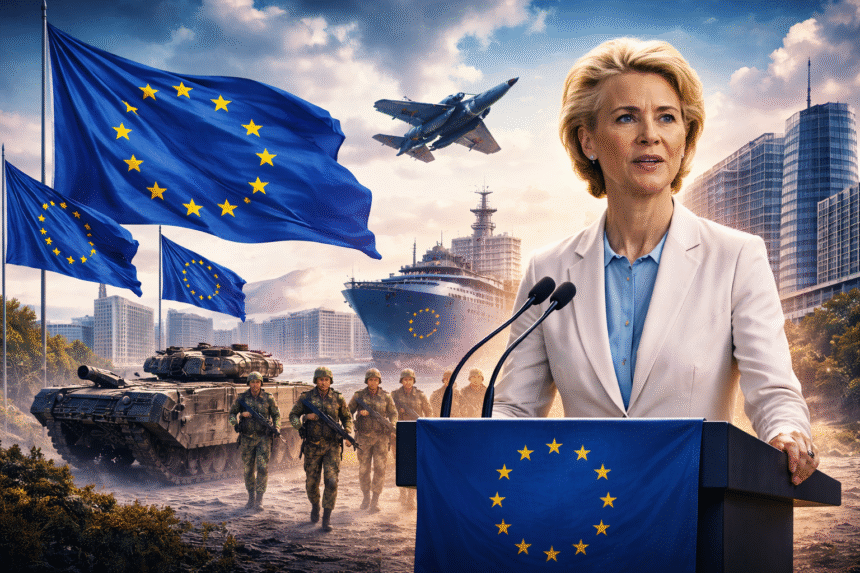
The President of the European Commission, Ursula von der Leyen, has underscored the need for Europe to take greater responsibility for its own security, warning that excessive reliance on external partners is no longer sustainable in an increasingly unstable global environment.
Speaking amid heightened geopolitical tensions, von der Leyen stressed that Europe faces a new era defined by strategic competition, military conflicts near its borders, and growing economic and technological rivalries. In this context, she argued, the continent must strengthen its ability to act independently while safeguarding its interests and citizens.
A Changing Global Landscape
According to the Commission President, recent crises—from the war in Ukraine to disruptions in global supply chains—have exposed Europe’s vulnerabilities. Dependence on external actors for energy, defense capabilities, and critical technologies has limited the EU’s room for maneuver during times of crisis.
Von der Leyen emphasized that Europe can no longer assume that security guarantees or economic stability will always be provided from outside the continent. Instead, the European Union must be prepared to respond decisively to threats, whether military, cyber, economic, or hybrid in nature.
Building European Strategic Autonomy
At the heart of her message is the concept of strategic autonomy. This includes strengthening Europe’s defense industrial base, investing in joint military capabilities, and improving coordination among member states. While cooperation with allies remains important, von der Leyen made clear that Europe must be capable of defending itself if circumstances require.
She also highlighted the importance of reducing dependence in key sectors such as energy, advanced technology, and critical raw materials. By diversifying supply chains and boosting domestic production, Europe aims to increase resilience against external pressure or coercion.
Security Without Isolation
The European Commission President was careful to note that greater self-reliance does not mean isolation. Europe, she said, remains committed to multilateralism and strong partnerships, particularly with like-minded allies. However, these partnerships should complement—not replace—Europe’s own capabilities.
Within the European Union, her remarks have renewed debate about defense spending, collective security initiatives, and the future role of Europe on the global stage.
A Call for Unity and Action
Von der Leyen concluded by urging EU member states to move beyond rhetoric and translate strategic ambitions into concrete action. Unity, she argued, is Europe’s greatest strength. By investing together in security, innovation, and resilience, Europe can ensure that it remains capable of defending its values and interests in an increasingly uncertain world.
Her message reflects a broader shift in European thinking: security is no longer a given, but a responsibility that Europe must be ready to shoulder on its own.