

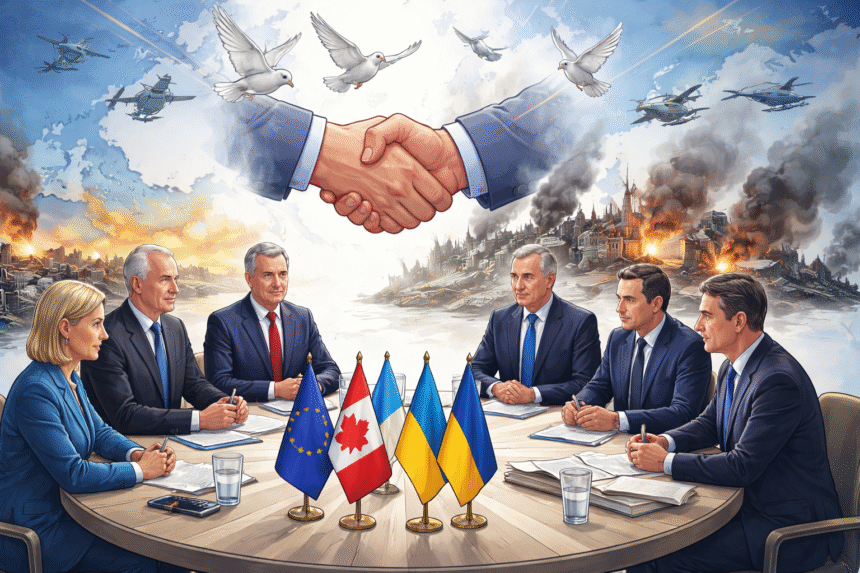
European and Canadian leaders have intensified diplomatic coordination over efforts to end the Russian-Ukrainian war, signaling cautious optimism that a pathway toward negotiations may be emerging after a series of discussions involving Washington and Kyiv.
During the talks, officials emphasized that any peace framework must respect Ukraine’s sovereignty, ensure long-term regional security, and avoid rewarding aggression. While no concrete agreement has yet been reached, diplomats described the tone as “more constructive” than in recent months, reflecting growing recognition of the war’s mounting humanitarian and economic toll.
Focus on Conditions — Not Just Ceasefire
European representatives stressed that an immediate ceasefire, while desirable, cannot become a “freeze” that allows fighting to resume later. Several leaders highlighted the need for verifiable security guarantees for Ukraine and mechanisms to prevent future escalations. Canada echoed this stance, reiterating its long-standing support for Ukraine’s territorial integrity and continued humanitarian assistance.
Behind the scenes, officials say discussions have touched on issues such as reconstruction support, potential prisoner exchanges, rebuilding damaged energy infrastructure, and the gradual easing — or tightening — of sanctions depending on compliance with any eventual agreement.
War Fatigue Meets Security Concerns
Across Europe, public concern continues to rise over energy prices, military spending pressures, and the humanitarian cost of the conflict. Yet leaders insist that ending the war at any price would risk destabilizing Europe further if Russia interprets concessions as a strategic victory.
Security analysts note that the ongoing diplomacy reflects a dual reality: Western governments want to avoid endless conflict, but they also want to ensure that Ukraine’s sovereignty remains protected and that deterrence in Europe remains credible.
A Cautious Path Forward
For now, both European and Canadian officials describe this phase as exploratory. Kyiv maintains that any peace effort must begin with respect for its internationally recognized borders, while Moscow continues to demand concessions that Western leaders consider unacceptable.
Despite these gaps, the renewed diplomatic attention suggests that stakeholders are probing for openings — whether through humanitarian corridors, localized ceasefires, or broader negotiation frameworks.
The coming months will likely determine whether these conversations evolve into meaningful progress or remain another chapter in the prolonged quest to end one of Europe’s most consequential conflicts in decades.