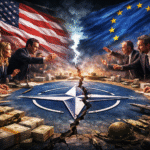


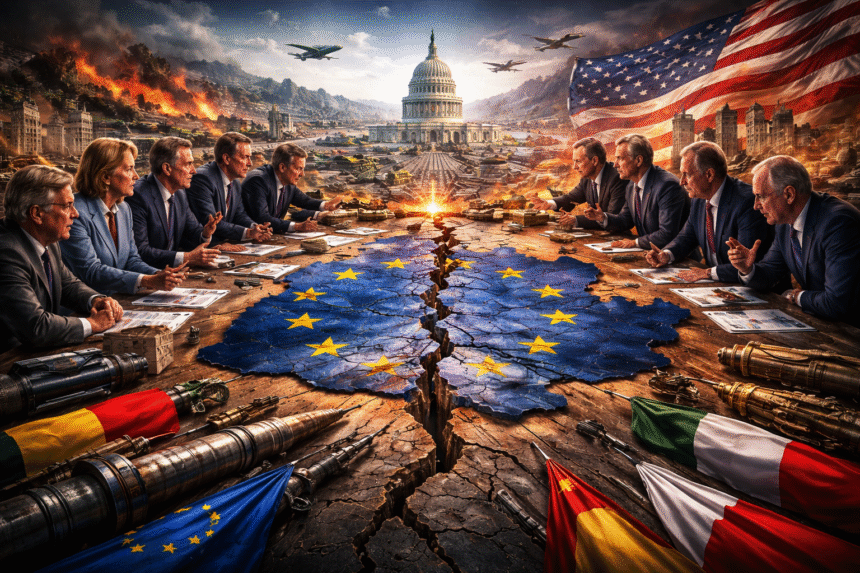
Europe is increasingly facing challenges in presenting a unified political and strategic stance, as deep-rooted differences in national interests and continued reliance on the United States for security expose growing fractures within the continent.
The European Union, long seen as a model of political and economic integration, is now grappling with internal divisions that are becoming more visible in times of global crisis. From foreign policy to defense strategy, member states often find themselves at odds, reflecting varying historical alliances, economic priorities, and threat perceptions.
One of the key factors behind this fragmentation is Europe’s dependence on the United States as the primary guarantor of its security. Through NATO, Washington continues to play a dominant role in shaping defense policies and providing military capabilities that many European countries lack. While this partnership has ensured stability for decades, it has also limited Europe’s ability to act independently on critical issues.
These dynamics are particularly evident in responses to international conflicts. Some European nations favor diplomatic engagement and de-escalation, while others advocate for stronger military alignment with the United States. This divergence not only weakens Europe’s collective voice but also complicates decision-making within EU institutions.
Economic considerations further deepen the divide. Countries with stronger trade ties to certain regions may prioritize stability and negotiation, while others, driven by security concerns, support tougher measures. The result is a patchwork of policies rather than a coherent strategy.
Analysts warn that this lack of unity could have significant consequences. A fragmented Europe risks losing influence on the global stage, as external powers may exploit divisions to advance their own interests. At the same time, internal disagreements could slow down responses to urgent challenges, from security threats to economic shocks.
Efforts to strengthen European strategic autonomy have gained momentum in recent years, with calls for increased defense spending, joint military capabilities, and reduced dependence on external partners. However, progress remains uneven, and political will varies across member states.
As global tensions rise, the pressure on Europe to overcome its internal divisions is intensifying. The ability to forge a unified position will not only determine its role in international affairs but also shape the future of its security and stability in an increasingly uncertain world.