


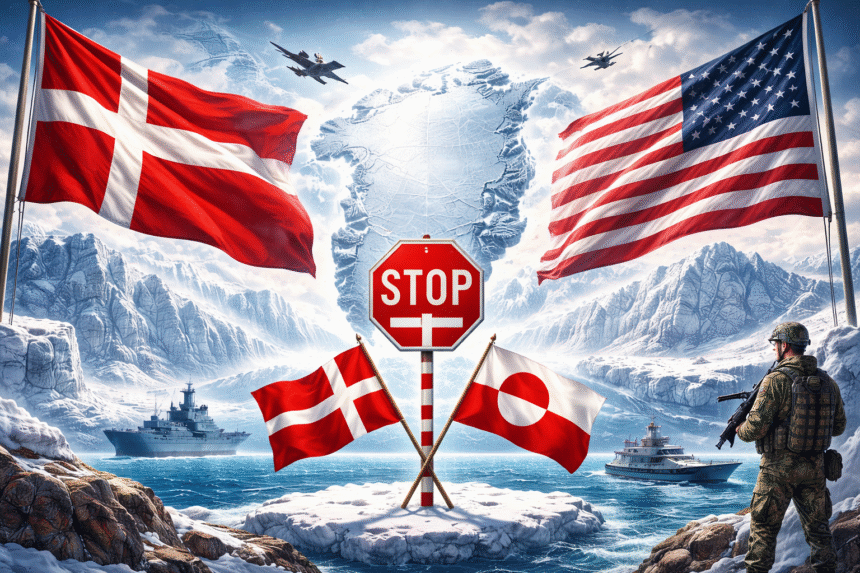
Denmark has reaffirmed that Greenland is an integral part of the Danish realm and that its sovereignty is non-negotiable, following provocative remarks by the U.S. president suggesting that Washington could seek greater control or influence over the Arctic territory.
Speaking in Copenhagen, Danish officials stressed that Greenland’s status is defined by international law and by the autonomous arrangements agreed upon with the island’s local government. Any suggestion that the United States could pressure Denmark or Greenland on territorial matters, they said, is “unacceptable and contrary to the principles of sovereignty and mutual respect.”
Clear Message to Washington
Denmark’s foreign minister emphasized that cooperation with the United States in the Arctic remains important — particularly on security, climate, and economic issues — but added that this cooperation does not extend to questions of ownership or control.
“Greenland is not for sale, nor is it subject to bargaining,” the minister said, underscoring that decisions about Greenland’s future belong to its people and within the framework of the Kingdom of Denmark.
Officials also noted that Copenhagen has communicated its position directly to U.S. counterparts, urging restraint in rhetoric that could destabilize long-standing diplomatic relations.
Greenland’s Strategic Importance
Greenland — the world’s largest island — holds significant strategic value. Its location in the Arctic places it at the center of global competition involving climate change, military positioning, and emerging maritime routes. The island also contains mineral resources that have attracted increasing international interest.
For the United States, Greenland hosts an important NATO-linked military installation at Thule Air Base. However, Denmark has insisted that security cooperation does not imply any weakening of territorial sovereignty.
Reactions in Greenland
Leaders in Greenland’s autonomous government echoed Denmark’s response, highlighting their desire for greater self-governance over internal affairs while maintaining international recognition of their territorial rights.
Greenlandic officials reiterated that external powers must respect both their autonomy and Denmark’s sovereign oversight. Many warned that careless statements from major powers risk turning the Arctic into a zone of political confrontation.
Broader Diplomatic Implications
Analysts say the episode is the latest reminder of intensifying geopolitical competition in the Arctic, where Russia, China, the United States, and European states all seek influence.
For Denmark, the controversy has served as an opportunity to signal firmness:
- Sovereignty is non-negotiable
- Arctic cooperation must follow international law
- Dialogue, not pressure, will shape future relations
Despite tensions, Danish officials have made clear they prefer to maintain strong ties with Washington — provided that mutual respect remains the foundation.
Looking Ahead
Diplomatic observers expect further discussions between Copenhagen, Washington, and Nuuk (Greenland’s capital) over Arctic policy, climate security, and infrastructure development.