


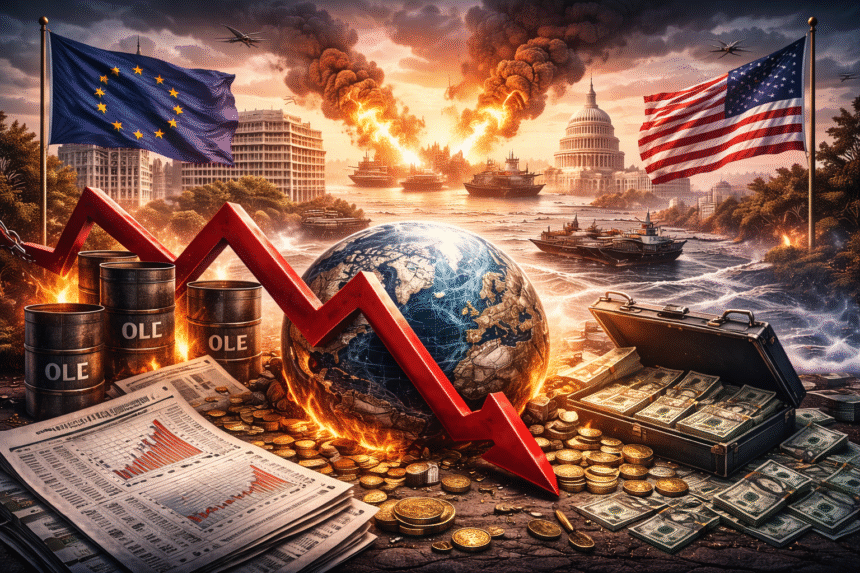
Major U.S. newspapers and financial commentaries are increasingly sounding the alarm about the potential economic fallout if European countries become more directly involved in the widening conflict between the United States, Israel, and Iran. The warnings emphasize that deeper European engagement — militarily or economically — could have far-reaching consequences for the global economy, particularly through energy markets, inflation, and supply chains.
Heightened Economic Risks Amid Escalation
American analysts and newspaper editorials are highlighting several key areas of concern:
- Energy prices and inflation: The ongoing conflict has already disrupted oil and gas markets. The Strait of Hormuz crisis, triggered by Iran’s threats and subsequent disruptions to shipping, has significantly curtailed tanker traffic — a vital route for roughly 20 % of the world’s crude and LNG exports — leading to sharp increases in global energy prices. This surge is expected to feed into inflationary pressures in both Europe and the United States, squeezing households and businesses alike.
- Global supply chain uncertainty: With major shipping routes under strain and insurance costs for vessels spiking, companies face rising logistics costs and delivery delays. This jeopardizes trade flows not only for energy but also for manufacturing components, agricultural commodities, and industrial raw materials.
- Financial market volatility: U.S. financial media have reported increased risk sentiment in markets, with warnings from banking leaders that geopolitical uncertainty — especially if Europe becomes more entangled — could unsettle equities and bond markets. Expert commentary has described the war risks as a factor that could derail market confidence if the conflict persists.
🇪🇺 Europe’s Economic Exposure
American coverage notes that Europe is especially vulnerable due to its significant reliance on imported energy. If conflict-related disruptions continue:
- Inflation could rise more quickly across the eurozone as energy costs trickle through consumer prices and business input costs. European Central Bank officials have already cautioned that a protracted war could push inflation above target and slow growth.
- Growth prospects may dim: Commentary in U.S. financial media suggests that Europe’s fragile recovery could be derailed if higher energy prices persist and dampen industrial output and consumer spending. Analysts stress that the next weeks will be critical in determining whether the impact remains a temporary “speed bump” or morphs into a broader economic setback.
Political and Strategic Calculations
American editorial voices also warn that greater European involvement — whether through logistical support, sanctions enforcement, or military cooperation — risks deepening tensions with Tehran and potentially broadening the conflict. Such escalation could accelerate:
- Oil price shocks, as Iran threatens key maritime chokepoints.
- Retaliatory cyber or military responses targeting Western infrastructure.
- Strains on NATO cohesion, as member states balance support for the U.S. with domestic economic and political pressures.
Broader Global Impact
Beyond Europe and the U.S., global markets feel the strain:
- Analysts in U.S. newspapers note that Asian economies — heavily dependent on Middle Eastern oil — face their own inflation and growth challenges as prices rise.
- Investors are reckoning with higher uncertainty, which could affect capital flows and investment decisions worldwide.
Conclusion: A Conflict with Global Economic Stakes
American newspapers’ warnings reflect a growing consensus among economists and strategists: if the Middle East conflict widens to involve European countries more directly, the economic fallout could be significant and long-lasting, affecting energy prices, inflation, trade, and financial stability across the globe.