

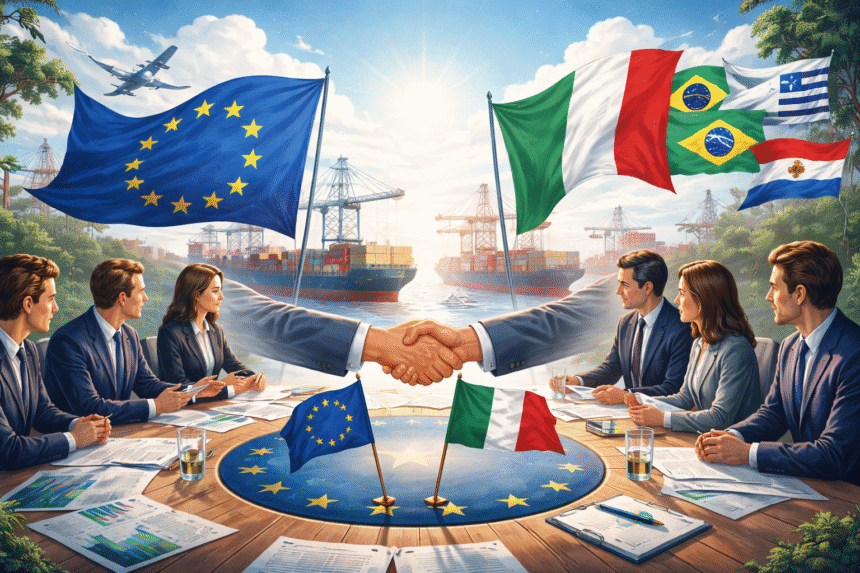
The European Union is intensifying diplomatic efforts to secure Italy’s support for the long-awaited trade agreement with the Mercosur bloc, as Brussels moves closer to finalizing one of the world’s largest free-trade deals. EU officials see Italy’s position as pivotal, especially amid growing internal divisions over the agreement’s economic and environmental implications.
The Mercosur deal — negotiated between the EU and South America’s Mercosur countries (Brazil, Argentina, Uruguay, and Paraguay) — aims to create a vast trade area covering more than 700 million people. Supporters argue it would significantly boost European exports, particularly in industrial goods, machinery, pharmaceuticals, and services, while strengthening the EU’s geopolitical influence in Latin America.
However, Italy has expressed reservations, largely reflecting concerns from its agricultural sector. Italian farmers fear increased competition from South American agricultural imports, particularly beef, poultry, and sugar, which they argue could undercut European producers due to lower production costs and differing environmental standards. These concerns echo similar objections raised by France and several other EU member states.
In response, European Commission officials are engaging Rome with assurances that protective safeguards will be built into the agreement. These include quotas on sensitive agricultural imports, strict enforcement of EU food safety rules, and commitments related to environmental and labor standards. Brussels has emphasized that the deal will not weaken European climate policies, a key political issue within Italy and across the EU.
From the EU’s perspective, winning Italy’s support is crucial to building the qualified majority needed to move the agreement forward. With global trade increasingly shaped by geopolitical rivalry, EU leaders argue that delaying the Mercosur deal would risk ceding economic and strategic ground to competitors such as China and the United States, both of which have expanded their influence in South America.
Italian officials have so far stopped short of outright rejection, signaling openness to further negotiations and clarifications. Observers say Rome’s final stance may depend on the extent of concessions offered to protect domestic agriculture and whether additional guarantees can be secured on sustainability and fair competition.
As talks continue, the coming weeks will be decisive. If the EU succeeds in aligning Italy with the deal, momentum toward signing could accelerate. Failure, however, would expose deeper fractures within the bloc over trade policy, environmental priorities, and the balance between globalization and domestic economic protection.