

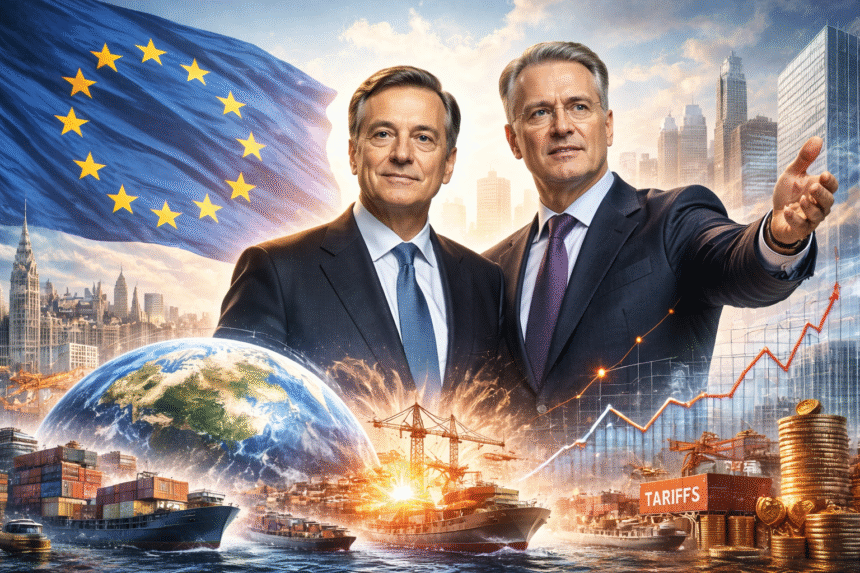
As Europe grapples with the economic fallout from rising global trade tensions and tariff barriers, the head of the Organisation for Economic Co-operation and Development (OECD) has called on European policymakers to pay close attention to the economic prescriptions of Mario Draghi, the former president of the European Central Bank.
Speaking at the World Governments Summit in Dubai, OECD Secretary-General Mathias Cormann stressed that despite the persistence of trade tariffs and protectionist pressures around the world, Europe’s economy would benefit from considering Draghi’s recommendations on structural reform and deeper integration within the bloc.
Cormann described the European Union as a “uniquely successful story” but acknowledged that it now faces mounting structural challenges in a global trading environment marked by rising barriers and geopolitical competition. He urged EU leaders to “listen carefully” to Draghi’s advice on how to adapt and strengthen the bloc’s economic foundations.
Draghi, who has been a leading voice on the future of the EU economy, has repeatedly argued that the Union must evolve beyond its current configuration and adopt deeper political and economic integration to remain competitive on the global stage. His ideas include fostering a more cohesive fiscal and investment policy and enhancing joint capacity to respond to external economic shocks such as tariffs and market distortions.
Tariffs imposed by major trading partners — particularly the United States — have become a central concern for European economic planners. These measures have disrupted traditional export markets and heightened uncertainty for European manufacturers and exporters. Analysts say that sustained tariff pressures risk slowing growth, reducing investment, and complicating recovery prospects in key sectors.
Although multilateral trade cooperation remains a cornerstone of the OECD’s outlook, Cormann noted that global appetite for such cooperation is being tested by escalating trade barriers. He pointed out that economies around the world — including Europe — need to maintain strong engagement with international trade rules and institutions if they are to manage the effects of tariffs and avoid deeper economic fragmentation.
The call to heed Draghi’s guidance comes as EU leaders prepare for upcoming summits that will address competitiveness, investment, and the broader strategic direction of the bloc’s economy. With growth prospects facing pressures from external tariffs and internal structural bottlenecks, policymakers will be under growing pressure to find a balanced agenda that promotes resilience, innovation, and shared prosperity across the Union.