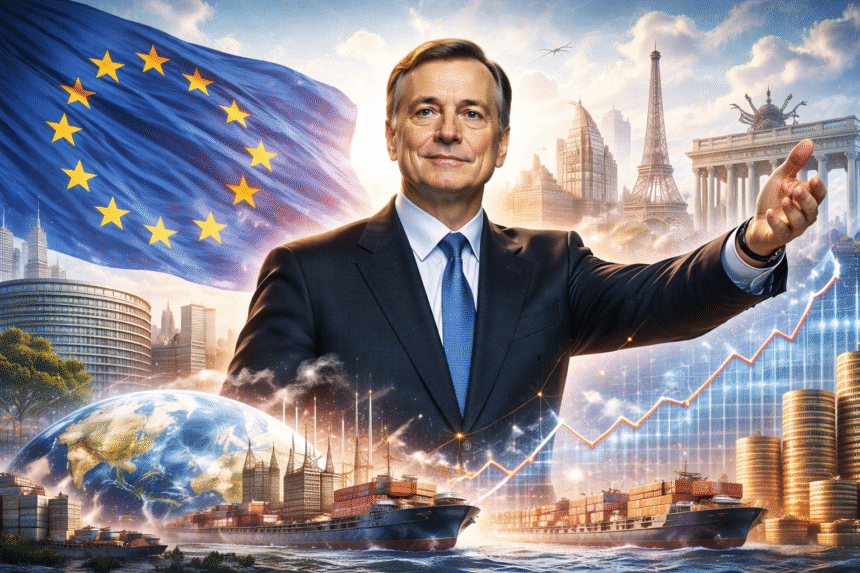
Former European Central Bank president and ex-Italian prime minister Mario Draghi delivered a stark warning to European leaders this week, urging the European Union (EU) to overcome internal divisions and adopt more unified policies if it seeks to avoid political fragmentation and industrial decline.
In a major speech at KU Leuven University in Belgium, Draghi said the EU must move beyond its current loose confederation of sovereign states toward a more cohesive political and economic union — a shift he described as essential for Europe to act as a global power amid intensifying geopolitical competition.
“The choice before us is clear: Europe can either remain a large market shaped by external priorities, or it can take decisive steps toward unity and strength,” Draghi said, emphasizing that a divided Europe risks losing strategic autonomy and influence.
Draghi warned that the existing global order has weakened, with major powers like the United States and China increasingly asserting their interests through tariffs, supply-chain leverage, and geopolitical competition. Without unified policies in areas such as defence, industrial strategy and foreign affairs, he argued, the EU is vulnerable to being “picked off” by external actors.
According to Draghi, Europe already demonstrates its potential as a unified actor in fields where it has integrated — such as the single market, trade policy, competition rules and monetary policy — negotiating on the world stage with a single voice. But he stressed that this model must expand into other policy areas to avoid fragmentation and industrial decline.
“Where Europe has federated — such as in monetary policy — it is respected as a power and negotiates as one. Where it has not — like defence and industrial policy — it remains treated as an assembly of medium-sized states,” he said.
Draghi’s remarks come ahead of an informal EU leaders’ summit on competitiveness scheduled for mid-February, where discussions are expected to focus on enhancing the bloc’s strategic autonomy, reforming industrial policy, and strengthening cohesion among member states.
Analysts say the former central banker’s call for deeper integration highlights long-standing debates within the EU over how to balance national sovereignty with the need for collective action in the face of global economic pressures.