

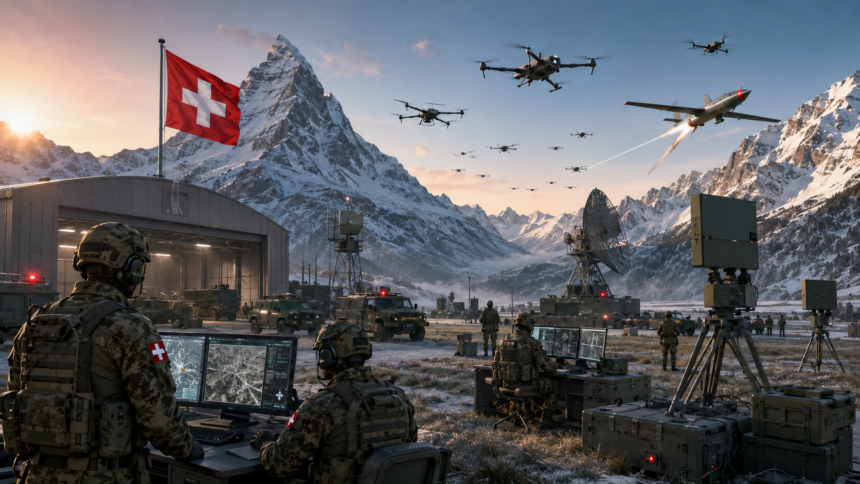
Switzerland is planning to establish a dedicated military drone battalion by 2028 as part of a broader effort to modernize its armed forces and respond to rapidly evolving security threats.
The new unit will specialize in drone reconnaissance, operational deployment and defense against hostile unmanned aircraft. Swiss authorities also intend to create a dedicated recruitment and training school to prepare military personnel for drone-related missions.
The plan reflects lessons from recent conflicts, particularly the war in Ukraine, where relatively inexpensive drones have transformed surveillance, targeting and battlefield operations. Unmanned systems are now used for intelligence gathering, attacks, logistics and protection against enemy aircraft.
Switzerland also plans to establish a national drone center that will bring together the armed forces, defense manufacturers, technology companies and universities. The center will help develop, test and integrate new systems into military operations.
Bern is seeking to strengthen domestic production and reduce its dependence on international supply chains. Switzerland’s existing Drone Taskforce, launched in 2024, has focused on developing small and medium-sized aircraft in cooperation with the country’s industrial and academic sectors.
Projects under examination include drones capable of engaging surface targets, systems designed to intercept hostile aircraft, multipurpose platforms and coordinated drone swarms. Some applications are being studied for operations over distances exceeding 300 kilometers.
The initiative also responds to unauthorized drone activity observed near military facilities and critical infrastructure across Europe. Such incidents have increased fears that unmanned aircraft could be used for espionage, sabotage or hybrid attacks below the threshold of conventional warfare.
Switzerland’s government has acknowledged that the country is not sufficiently protected against some emerging threats. Its recent defense plans prioritize ground-based air defense, counter-drone technology, cyber capabilities and protection against long-range attacks.
The government previously requested 3.4 billion Swiss francs in military spending, including around one billion francs for German-made IRIS-T SLM air-defense systems and approximately 70 million francs for protection against miniature drones.
The drone battalion forms part of a wider increase in Swiss security spending. Bern plans to allocate an additional 31 billion Swiss francs to defense and security programs over a ten-year period beginning in 2028, subject to political and public approval.
Although Switzerland maintains a policy of armed neutrality and is not a NATO member, the government argues that neutrality requires the country to possess credible defensive capabilities.
The Swiss initiative comes amid a broader wave of military investment across Europe. Governments are expanding air defenses, increasing ammunition production and developing unmanned systems as concerns grow about conventional warfare, infrastructure sabotage and hybrid security threats.