

Trade tensions are growing between the European Union and some of its closest European partners as Brussels introduces industrial policies designed to support manufacturers inside the bloc and reduce dependence on foreign suppliers.
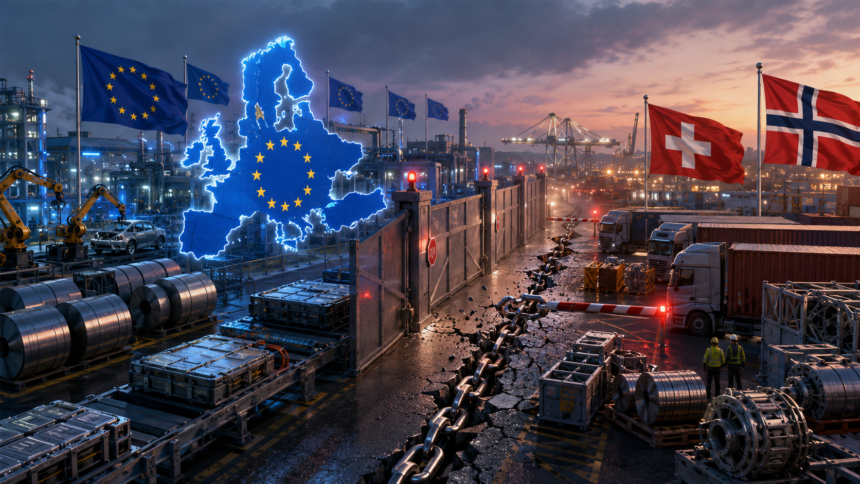
Switzerland, Norway, Iceland and Liechtenstein have expressed concern that new “Made in Europe” requirements, subsidies and import restrictions could exclude their companies from projects and markets despite decades of economic integration with the EU.
The European Union is developing these policies in response to increasing competition from China and the United States. Brussels wants to strengthen domestic manufacturing, secure strategic supply chains and encourage European production in sectors such as steel, aluminum, cement, electric vehicles, batteries and clean technology.
However, neighboring countries warn that defining eligible products too narrowly as those manufactured specifically within the EU could divide supply chains that extend beyond the Union’s political borders.
Switzerland is particularly concerned because its companies are deeply integrated with manufacturers in EU member states but the country is neither an EU nor a European Economic Area member. Swiss officials have urged Brussels to consider complete European value chains when designing industrial support measures.
The EU’s new steel safeguards illustrate the problem. Measures introduced in July reduced duty-free import volumes and imposed a 50% tariff on steel entering above the established quotas. Switzerland is covered by the restrictions and has been seeking exemptions to protect its exporters.
Norway occupies a different position. As a member of the European Economic Area, it participates extensively in the EU single market and has been exempted from some measures, including the latest steel tariff quotas. Nevertheless, Oslo fears that future procurement, subsidy and industrial rules could distinguish between EU members and closely associated countries.
Norway supplies the Union with energy, critical raw materials, metals and industrial components. Norwegian companies are also closely connected to European battery, renewable-energy and defense supply chains.
Switzerland and the EEA countries accept many EU rules and contribute financially to European programs in exchange for varying levels of access to the single market. Yet they have limited influence over the policies adopted in Brussels.
The dispute has highlighted this imbalance. Decisions intended to protect EU manufacturers can have significant consequences for neighboring economies even though their governments do not participate directly in the Union’s legislative process.
Supporters of the EU’s strategy argue that stronger domestic-content rules are necessary to protect European jobs and prevent public subsidies from supporting foreign industrial overcapacity. They also contend that Europe must improve its economic security following disruptions caused by geopolitical conflicts and global competition.
Critics, however, warn that excluding closely integrated partners could increase production costs, weaken supply chains and reduce Europe’s overall competitiveness. They argue that “Made in Europe” should reflect the continent’s interconnected economy rather than the EU’s formal borders alone.
The challenge for Brussels will be to protect strategic industries without alienating the neighboring countries that supply essential materials, technology and energy. How the EU defines “European” production could determine whether its industrial strategy strengthens the wider region or creates new economic divisions within it.