


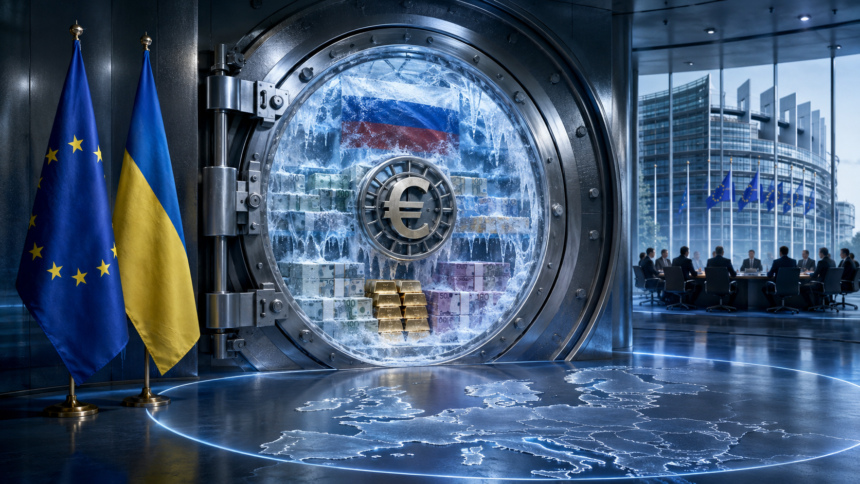
Four European Union countries are calling for renewed negotiations on using approximately €210 billion in frozen Russian central bank assets to support Ukraine, reviving a politically and legally contentious proposal that previously failed to secure unanimous backing.
The foreign ministers of the Netherlands, Poland, Spain and Sweden urged the EU to return to the issue as Ukraine faces growing military and financial requirements. The four governments want the matter discussed during an informal meeting of EU foreign ministers in Ireland on September 1 and 2.
In a joint letter addressed to EU foreign policy chief Kaja Kallas and Irish Foreign Minister Helen McEntee, the ministers argued that the financial assistance already approved for Ukraine would not be sufficient to meet its needs.
EU leaders previously agreed to provide Ukraine with a €90 billion loan covering 2026 and 2027. However, the four countries believe that additional resources will be necessary as the war continues and Kyiv faces rising defense, reconstruction and budgetary costs.
Around €210 billion in Russian central bank assets have been immobilized across the European Union under sanctions imposed following Russia’s full-scale invasion of Ukraine. Approximately €185 billion of that amount is held by Euroclear, the Brussels-based financial clearing institution.
Supporters of using the assets argue that Russia should bear the financial consequences of the destruction caused by the war. They say directing the funds toward Ukraine’s defense now would be more effective than waiting until the end of the conflict to use them for reconstruction.
The proposal does not necessarily involve directly confiscating and transferring the entire amount. Previous plans examined using the immobilized assets as the financial basis for a large reparations loan to Ukraine, which would only be repaid if Russia eventually paid compensation.
An earlier proposal could have provided Ukraine with around €165 billion. It failed after Belgium opposed the plan, warning that the country could face disproportionate legal and financial risks because most of the assets are held in Brussels.
Belgium has sought guarantees that potential costs arising from Russian lawsuits, retaliatory measures or market disruption would be shared among all EU members. Its position reportedly remains unchanged.
Other critics have warned that seizing sovereign central bank assets could undermine investor confidence in the euro and encourage foreign governments to move their reserves away from European financial institutions.
The EU is already using profits generated by the immobilized assets to help Ukraine repay loans provided under a broader Group of Seven initiative. However, the underlying Russian assets remain frozen and have not been permanently confiscated.
The renewed initiative is expected to reopen divisions within the Union over legality, financial stability and collective responsibility. Approval of any major new mechanism would require extensive negotiations and guarantees capable of addressing Belgium’s concerns.
The debate is also likely to become linked to negotiations over the EU’s long-term budget for 2028–2034, as member states consider how to fund Ukraine without placing unsustainable pressure on their national finances.