

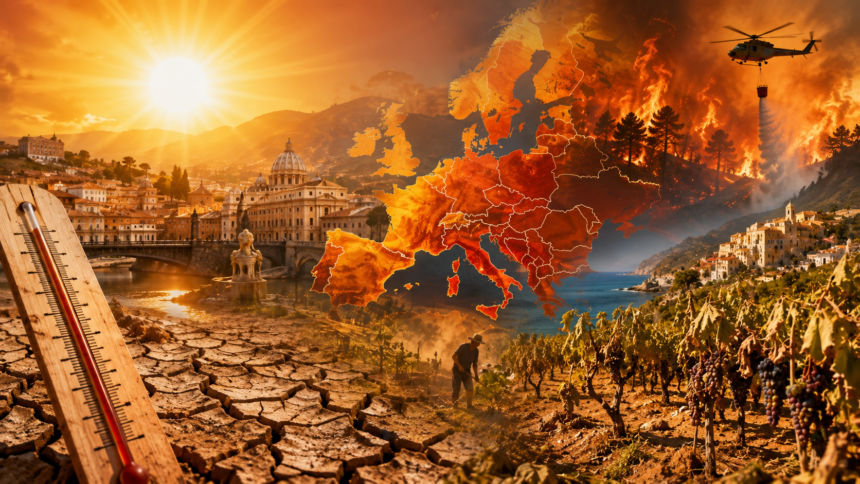
Europe’s extreme summer of 2026 is continuing to leave a visible mark across the continent, with record temperatures, prolonged drought and destructive wildfires increasingly affecting agriculture, public health and everyday life.
NASA’s Earth Observatory has documented the severe conditions from space, including major wildfires in Spain and France during July, where intense heatwaves combined with prolonged drought to create some of the most disruptive fires the two countries have experienced in decades. Satellite imagery showed large burned areas across western Europe as the summer heat intensified.
Western Europe also recorded its hottest combined June and July on record in 2026, according to Copernicus data reported this month. The region’s average temperature over the two months reached 21.62°C, surpassing the previous record set in 2022. Nearly 120 million Europeans lived in areas where July was the hottest ever recorded locally.
Sicily Becomes a Symbol of Europe’s Changing Climate
Few places illustrate the consequences as clearly as Floridia in Sicily, where residents are confronting increasingly intense and persistent heat.
The Sicilian town became internationally known after recording 48.8°C in August 2021, recognized as Europe’s highest temperature. Five years later, residents say the problem is no longer simply about breaking individual temperature records — prolonged heat is changing how people live.
During the hottest hours, streets and public squares can become nearly deserted as residents remain indoors. Even traditional evening socializing has become harder because nighttime temperatures often remain uncomfortably high.
Local residents have described extreme summer heat as increasingly resembling a seasonal lockdown, restricting outdoor activity and reducing social interaction.
Agriculture Under Increasing Pressure
The consequences are particularly serious for farming.
In Sicilian vineyards, some agricultural workers have shifted their schedules to before sunrise, attempting to finish physically demanding work before temperatures approach 40°C.
Wine producers say rising temperatures are also accelerating the development of grapes, compressing biological processes that once unfolded over much longer periods into only a few weeks.
Other parts of Europe are facing similar pressures. Severe drought and extreme heat could significantly reduce maize production in France, while agricultural regions in Germany, Italy and Austria are also reporting crop damage and water stress.
Heat, Drought and Wildfires Reinforce One Another
Europe’s extreme temperatures have occurred alongside exceptionally dry conditions.
Wildfires have forced evacuations in countries including France, Spain, Greece and Croatia, while authorities have faced simultaneous fires across several regions. Copernicus has warned of extremely dangerous wildfire conditions across parts of central and eastern Europe.
The World Meteorological Organization says extreme heat events are becoming more frequent, more intense and longer-lasting as the climate warms. Parts of Europe have already experienced repeated heatwaves during the 2026 summer season.
The effects extend beyond temperature records. Low river levels are disrupting shipping, agriculture and power generation, while drought is reducing crop yields and increasing pressure on water supplies.
A New Reality for European Summers
The summer of 2026 is increasingly demonstrating that extreme heat is not simply a weather story.
For farmers, it affects harvests and working hours. For cities, it changes when residents can safely spend time outdoors. For governments, it creates growing demands on firefighting, healthcare, water management and energy infrastructure.
Sicily provides one of the clearest examples of that transformation. A temperature record once treated as an extraordinary event is now part of a wider pattern of prolonged heat that is reshaping daily routines and livelihoods.
Across Europe, the challenge is therefore shifting from simply measuring new temperature records to adapting societies, agriculture and infrastructure to summers that are becoming hotter, drier and increasingly difficult to manage.