


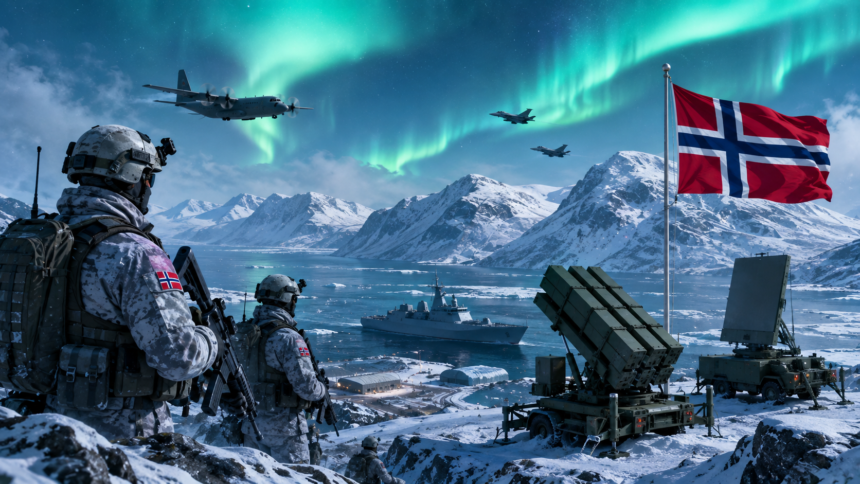
Norway is significantly strengthening its military presence in the Arctic, expanding its Finnmark Brigade as Oslo responds to a changing European security environment and heightened strategic competition in the High North.
The Norwegian military formally added an artillery battalion, an air-defense battery and a signals company to the brigade, marking a major increase in its combat capabilities. The Finnmark Brigade is headquartered at Porsangmoen in northern Norway, a strategically important region close to the country’s 198-kilometer border with Russia.
The brigade was established in August 2025 as Norway’s second army brigade and the country’s first new brigade since the end of the Cold War. Its expansion forms part of a wider effort to strengthen Norway’s ability to defend its northern territory and contribute to NATO operations in the Arctic.
New Artillery and Air-Defense Capabilities
The new artillery component will significantly extend the brigade’s reach. According to Brigade Commander Brigadier John Olav Fuglem, the artillery battalion will be capable of providing fire support at distances exceeding 40 kilometers, while the signals company will improve command and coordination between units.
Air defense is another central element of the expansion. Norway plans to integrate NASAMS and NOMADS air-defense systems into the Finnmark Brigade, strengthening its ability to protect military forces and strategically important areas from aerial threats. NASAMS is expected to be incorporated into the unit in 2027.
The brigade is also growing in personnel. Norway’s defense minister, Tore O. Sandvik, said its permanent workforce has increased from approximately 280 to 350 employees over the past year, alongside additional soldiers, equipment and military infrastructure.
Arctic Security Becomes a NATO Priority
Norway’s buildup reflects the Arctic’s increasing importance to European and NATO security. Russia maintains major military installations on the nearby Kola Peninsula, while the war in Ukraine has pushed Nordic governments to reassess their defense capabilities.
Norway, Finland and Sweden are now all NATO members, fundamentally changing the alliance’s strategic position across northern Europe. For Oslo, maintaining a credible military presence in Finnmark is particularly important because Norway shares both a land border and extensive Arctic maritime areas with Russia.
Norway has sharply increased defense spending in response to the deteriorating European security environment. Reuters estimates Norwegian defense expenditure at approximately 3.17% of GDP in 2026, placing the country among NATO members committing a substantial share of their economies to defense.
Norwegian officials emphasize that the expansion is defensive and designed to strengthen the country’s ability to protect Norwegian and NATO territory.
The transformation of the Finnmark Brigade therefore represents more than a domestic military restructuring. It is part of a wider shift in which the European Arctic is becoming an increasingly important front in NATO’s defense planning, as Norway and its allies prepare for a security environment very different from the relatively stable High North of the post-Cold War era.