

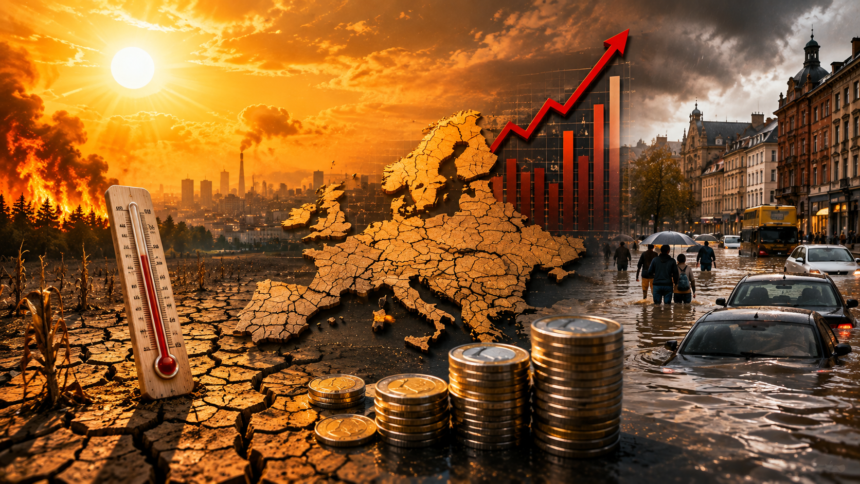
Europe is confronting an increasingly expensive consequence of climate change as heatwaves, floods, droughts and wildfires place growing pressure on businesses, households and government finances across the continent.
According to the European Environment Agency (EEA), weather- and climate-related extreme events caused an estimated €822 billion in economic losses across the European Union between 1980 and 2024, measured in 2024 prices. More than €208 billion — roughly a quarter of the entire total — occurred between 2021 and 2024 alone, highlighting how rapidly the financial burden has increased.
The trend is particularly striking when viewed over several decades. Average annual losses rose from around €8.6 billion in the 1980s to approximately €44.9 billion a year between 2020 and 2024, according to EEA figures. The agency says economic losses have increased over time and warns that intensifying extreme weather is likely to push costs still higher.
The financial pressure has become especially visible during Europe’s scorching 2026 summer. Reuters reported that repeated heatwaves are disrupting businesses, reducing productivity and increasing costs in sectors ranging from hospitality and agriculture to energy and transportation. In Padua, Italy, for example, more than 80% of surveyed hospitality businesses reported turnover falling by around 20% during recent periods of extreme heat.
France is also counting the cost. French Environment Minister Monique Barbut said recent heatwaves could generate between €10 billion and €15 billion in direct and indirect economic costs, with agriculture, water supplies and other sectors under significant strain.
The broader problem extends well beyond lost business revenue. Extreme weather can destroy homes and infrastructure, disrupt transport and electricity networks, damage crops and force governments to finance emergency responses and reconstruction.
Flooding represents the largest share of the EU’s recorded climate-related economic losses since 1980, accounting for approximately 47%, while storms account for around 27%. Heatwaves alone represent almost 18% of the total, according to the EEA.
Another major concern is the insurance gap. Reuters reported that much of Europe’s climate-related damage remains uninsured, leaving governments, companies and individuals to absorb significant portions of the financial burden. This is particularly challenging for heatwaves because losses such as reduced worker productivity, falling customer traffic and interruptions to normal business activity often do not qualify under conventional property insurance policies.
Governments are therefore facing mounting pressure to spend more on climate adaptation while already managing competing demands from defense, healthcare, aging populations and public debt.
The EEA estimates that climate-proofing Europe’s energy, transport and agricultural sectors could require between €53 billion and €137 billion annually by 2050, depending on future warming. Current committed funding for those sectors is estimated at only around €15–16 billion annually, leaving a substantial investment gap.
The figures illustrate a fundamental shift in Europe’s climate debate. Climate change is no longer solely an environmental challenge; it is increasingly becoming a question of economic resilience, insurance, infrastructure and public finances.
With Europe identified by the EEA as the world’s fastest-warming continent, governments face a difficult calculation: spend significantly more today to protect cities, infrastructure and businesses from extreme weather, or risk paying a much larger bill as heatwaves, floods, droughts and wildfires become increasingly severe.