


By using this site, you agree to the Privacy Policy and Terms of Use.
Accept
Euro Post.Euro Post.
Notification Show More
Aa
  • My Europe
    • Europe News
    • Social Issues
    • Immigration
    • EU Policies
    • EU Updates
  • World
    • Africa
    • Global Conflicts
    • Human Rights
    • Middle East
    • Latin America
    • Ukraine Crisis:
  • Business
    BusinessShow More
    Lamborghini Unleashes the Temerario: A Hybrid Supercar Poised to Surpass the Huracán
    July 26, 2025
    Is Waze Nearing the End of the Road? Google Maps Growth Raises Questions About the Future of the Navigation App
    July 26, 2025
    Germany Secures Fourth Conviction in €195 Million EU-Wide VAT Fraud Case Tied to Covid Mask Scam
    July 25, 2025
    AstraZeneca Commits $50 Billion Investment in U.S. Amid Tariff Pressures
    July 23, 2025
    ASML Shares Fall as Trump-Era Tariff Fears Cloud 2026 Growth Outlook
    July 17, 2025
  • Sport
  • Travel
  • Culture
    • Art/Design
    • Literature
    • Music
    • Film – TV
    • Fashion
Reading: Increasing Pressure on Dutch Dikes and River Transport in Germany
Share
Aa
Euro Post.Euro Post.
  • My Europe
  • World
  • Business
  • Sport
  • Travel
  • Culture
Search
  • My Europe
    • Europe News
    • Social Issues
    • Immigration
    • EU Policies
    • EU Updates
  • World
    • Africa
    • Global Conflicts
    • Human Rights
    • Middle East
    • Latin America
    • Ukraine Crisis:
  • Business
  • Sport
  • Travel
  • Culture
    • Art/Design
    • Literature
    • Music
    • Film – TV
    • Fashion
Follow US
  • Advertise
© 2021 Euro Post Agency.com. All Rights Reserved.
Euro Post. > Blog > My Europe > Europe News > Increasing Pressure on Dutch Dikes and River Transport in Germany
Europe News

Increasing Pressure on Dutch Dikes and River Transport in Germany

World News
By World News Published August 12, 2026
Share

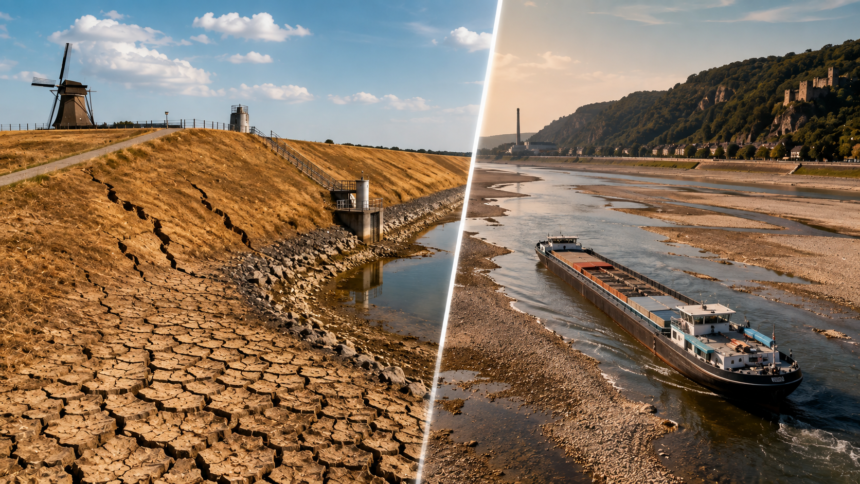
Persistent heat and drought across northwestern Europe are putting unusual pressure on the Netherlands’ famous dike system while historically low water levels on the Rhine are increasingly disrupting cargo transport and industrial supply chains in Germany.

In the Netherlands, prolonged dry conditions are causing some earthen dikes to dry out and crack, prompting water authorities to increase inspections. These structures normally rely partly on moisture to maintain their strength, and extended periods of extreme heat can weaken their surface and create potential vulnerabilities. Inspectors have been checking dry grass and soil for cracks, leaks and other warning signs.

The drought is also affecting the Rhine as it enters the Netherlands. At the Dutch border, the river recently fell to 6.47 metres above NAP, breaking the previous historic low recorded during the severe drought of 2022. Rhine flows have fallen to levels not seen in decades, forcing cargo vessels to reduce their loads to avoid running aground.

The situation is becoming particularly serious in Germany, where the Rhine serves as one of Europe’s most important industrial transport corridors. Water levels have reached new lows, forcing some operators to suspend sailings on sections of the river and others to dramatically reduce the amount of cargo they carry.

German shipping companies have warned that extremely shallow water around Kaub, a crucial bottleneck on the Middle Rhine, could effectively divide the river into two navigable sections if conditions deteriorate further. Such a disruption would interfere with the movement of fuel, chemicals, minerals, agricultural products and other bulk commodities between Germany’s industrial regions and major North Sea ports.

Industry is already feeling the effects. Chemical producers and other manufacturers have reported reduced deliveries, while businesses are increasingly turning to trucks and trains as alternatives. Several German states have temporarily relaxed restrictions on Sunday truck movements to help compensate for disrupted river transport.

The drought illustrates how Europe’s prolonged summer heat is increasingly becoming an infrastructure and economic problem as well as an environmental one. In the Netherlands, authorities must protect water infrastructure during unusually dry conditions, while Germany faces rising transportation costs and potential supply-chain disruptions if the Rhine remains critically low.

Without significant and sustained rainfall, pressure on both Dutch water management systems and German river commerce is likely to continue through the remainder of the summer.


You Might Also Like

European Union Condemns Belarus Labeling Euronews as ‘Extremist’

Latvia Strengthens Border Security With Belarus Amid Rising Migration

European Heatwave Keeps Breaking Temperature Records

Fears of Fires as Tourists Flock to See the Eclipse in Spain

Drought Lowers Italy’s Po River to Historic Levels

World News August 12, 2026 August 12, 2026
Share This Article
Facebook Twitter Whatsapp Whatsapp Email Print
What do you think?
Love0
Sad0
Angry0
Dead0
Previous Article European Heatwave Keeps Breaking Temperature Records
Next Article Repercussions Continue After Major Ukrainian Drone Attack Deep Inside Russia

Stay Connected

16k Like
85k Follow
45.6k Subscribe
Telegram Follow
- Advertisement -

Latest News

European Union Condemns Belarus Labeling Euronews as ‘Extremist’
Europe News
Latvia Strengthens Border Security With Belarus Amid Rising Migration
Europe News
Repercussions Continue After Major Ukrainian Drone Attack Deep Inside Russia
Ukraine Crisis:
European Heatwave Keeps Breaking Temperature Records
Europe News
Loading

Stay Informed,Europ’s Vioce Unfolded

Sign Up for Our Newsletter

Subscribe to our newsletter to get our newest articles instantly!

Loading
© 2022 Euro Post Agency. All Rights Reserved.