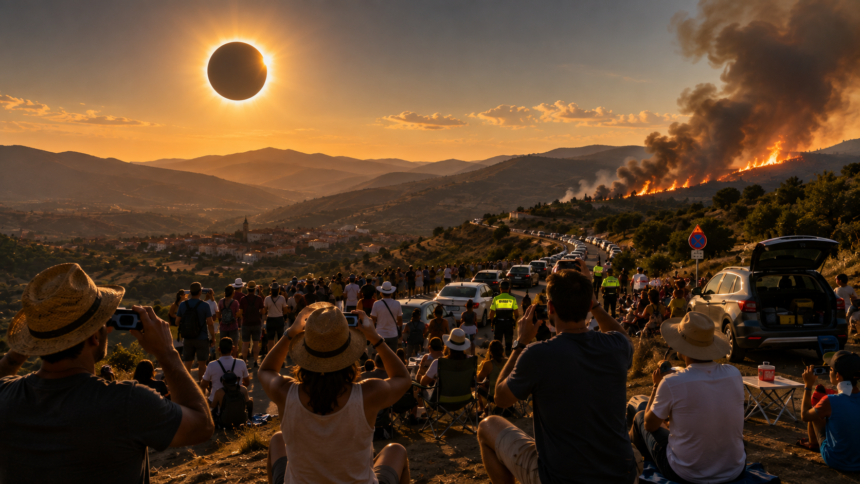
Spanish authorities are on heightened alert as millions of people travel across the country to watch Wednesday’s total solar eclipse, amid fears that the huge influx into rural areas could trigger new wildfires during one of Spain’s most dangerous fire periods of the year.
Authorities expect as many as six million people to gather along the eclipse’s path, with around 1.5 million additional car journeys anticipated. Spain has established approximately 660 official observation sites, while more than 35,000 police and security officers are being deployed as part of a nationwide safety operation.
The concern is particularly acute because Spain is experiencing severe heat and extremely dry conditions. Officials and forestry experts warn that dry vegetation can ignite from something as small as a discarded cigarette, improperly parked vehicle or other accidental spark. Heavy traffic on rural roads could also obstruct firefighters and emergency vehicles if a blaze breaks out.
The threat is far from theoretical. Major wildfires have already been burning in provinces including Huelva, Segovia and Huesca, while fires have scorched roughly 200,000 hectares across Spain so far this year — around six times the area burned by the same point in 2025, according to Environment Ministry figures cited by Reuters.
Some regional authorities have introduced additional restrictions ahead of the eclipse. Measures include bans on barbecues and fireworks, restrictions on parking near dry vegetation and closures of certain natural parks and rural paths. Some municipalities have even cancelled planned eclipse gatherings because of the fire danger.
The eclipse has nevertheless generated enormous interest among international visitors. Around 460,000 foreign tourists are expected to travel to Spain for the event, while accommodation in several prime viewing areas has been heavily booked. Northern and central Spain are among the most popular destinations because they lie within the path of totality.
Officials are urging spectators to use designated viewing areas, avoid unnecessary travel into vulnerable forests and ensure that roads remain accessible to emergency services. With extreme heat, drought, huge crowds and active wildfires converging on the same day, authorities are hoping that one of Spain’s most anticipated astronomical events does not become the trigger for another environmental emergency.