


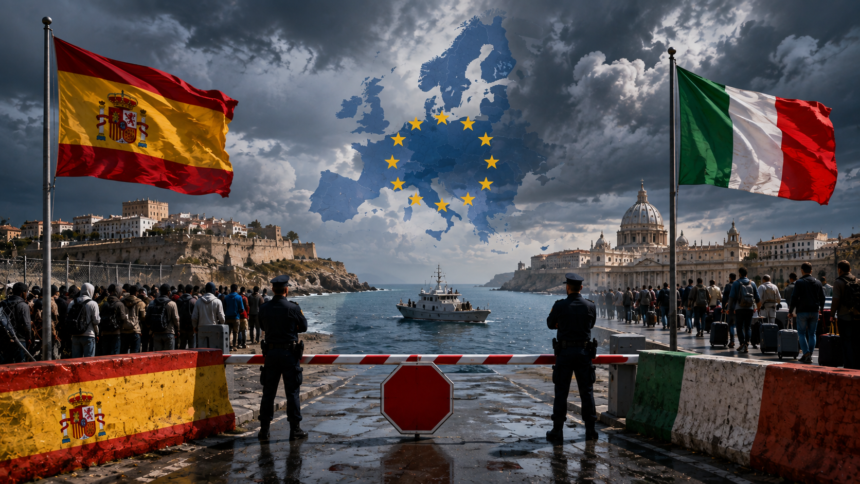
Tensions between Spain and Italy have escalated sharply as the migration crisis in Ceuta develops into a broader European dispute over border controls, migration policy and the future of free movement within the Schengen area.
The confrontation intensified after Italy temporarily reintroduced border checks on travelers arriving from Spain following the mass movement of migrants from Morocco into the Spanish enclave of Ceuta. Rome argued that the exceptional migration situation created security and migration-management concerns requiring additional controls.
Madrid strongly objected to the Italian decision and demanded that the restrictions be removed. When Italy refused, Spain responded by introducing temporary checks of its own on passengers arriving from Italy by air and sea, transforming what began as a migration emergency on Europe’s southern frontier into a diplomatic dispute between two major EU members.
Spain began implementing the measures over the weekend, with authorities conducting checks on passengers arriving from Italy. The move marked an unusual escalation between two countries that are both members of the European Union and the passport-free Schengen area.
Italian authorities have criticized Spain’s retaliatory measures, while Madrid has defended them as a proportionate response to Rome’s earlier decision.
At the center of the dispute is the sudden migration surge into Ceuta, the Spanish territory on the North African coast that shares a land border with Morocco. The episode placed Spanish authorities under intense pressure and revived wider European arguments about responsibility for controlling the EU’s external borders.
The confrontation also exposes longstanding differences between Spain and Italy over migration. Both countries are major entry points for migrants attempting to reach Europe from Africa, but their governments have frequently taken different political approaches to asylum, border enforcement and cooperation with countries of origin and transit.
Italian Prime Minister Giorgia Meloni has championed tougher controls on irregular migration and agreements with African and Mediterranean countries designed to reduce departures toward Europe. Spanish Prime Minister Pedro Sánchez’s government has defended its own approach while facing growing political pressure following the Ceuta crisis.
The dispute now has implications beyond bilateral relations because Spain and Italy are members of the Schengen area, where travelers normally move between participating countries without routine internal border checks.
European rules allow governments to temporarily restore such controls under exceptional circumstances, but their increasing use has raised concerns that migration and security pressures could gradually weaken one of the European Union’s most visible achievements: passport-free movement across much of the continent.
The Ceuta crisis has therefore evolved into more than a dispute about migration at Spain’s border with Morocco. It has reopened fundamental questions about which EU countries should carry responsibility when large numbers of migrants reach the bloc, how other member states should respond, and how far national governments can go in protecting their borders without undermining European freedom of movement.
With neither Madrid nor Rome initially willing to back down, the dispute demonstrates how quickly pressure at an external European border can spread into relations between EU governments and create new tensions inside the Schengen system.