

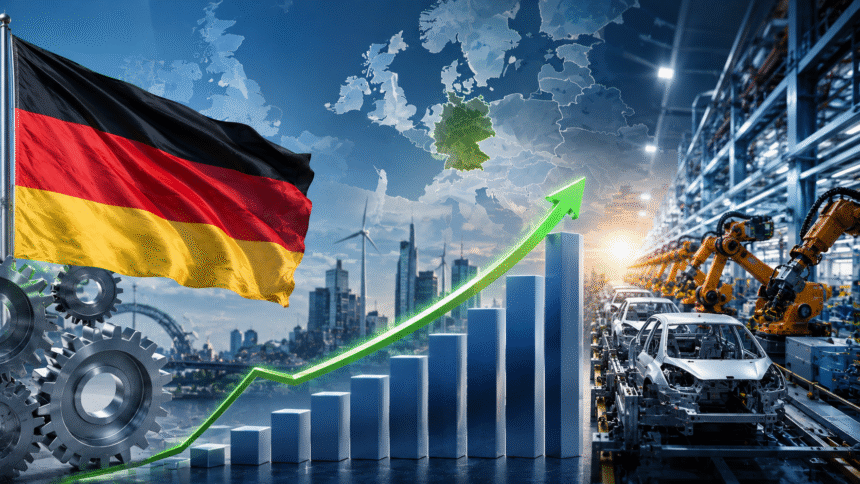
Germany’s economy has recorded its first increase in industrial production this year, offering a positive signal for European markets and raising hopes that Europe’s largest economy may finally be emerging from months of economic slowdown and weak manufacturing performance.
According to newly released economic data, German industrial output showed modest but important growth after a prolonged period of stagnation that affected several key sectors, including manufacturing, automotive production, machinery, and exports. Economists described the improvement as an encouraging development for both Germany and the broader European economy, which has been struggling with inflation, energy pressures, and declining industrial demand.
The recovery in production comes after months of concern over weakening economic indicators in Germany, where high energy costs, supply chain disruptions, and slowing global demand had placed heavy pressure on factories and exporters. Germany’s industrial sector is considered a critical pillar of the European economy, meaning any improvement is closely monitored by investors and policymakers across the continent.
Analysts say the latest figures may indicate that German manufacturers are gradually adapting to difficult market conditions, particularly after the stabilization of energy prices compared to previous years. Increased activity in engineering, electronics, and automotive industries also contributed to the improved results.
European financial markets reacted cautiously positively to the announcement, viewing the production increase as a potential early sign of broader economic recovery within the eurozone. Several investors had feared that prolonged weakness in Germany could drag down overall European growth throughout 2026.
Despite the improvement, economists warned that major challenges remain. Consumer demand across Europe continues to face pressure from high living costs and elevated interest rates, while global geopolitical tensions and uncertainty surrounding international trade continue to affect export-oriented industries.
Germany has also faced growing competition from Asian manufacturers and concerns about declining industrial competitiveness due to energy transition costs and regulatory burdens. Some business leaders have urged the German government to introduce additional economic stimulus measures and reduce bureaucracy to strengthen industrial growth.
The automotive sector, one of Germany’s most important industries, remains under close observation as manufacturers continue transitioning toward electric vehicle production while competing with rapidly expanding Chinese and American companies.
European Union officials welcomed the new industrial data, emphasizing the importance of maintaining economic stability and supporting innovation across European industries. Brussels has increasingly focused on policies aimed at strengthening industrial independence, expanding green technologies, and reducing reliance on foreign supply chains.
While one month of growth does not guarantee a long-term recovery, the latest figures have improved confidence among investors and business leaders who hope that Europe’s largest economy may be beginning a gradual rebound after a difficult economic period.
The coming months will likely determine whether the increase in industrial production represents the start of sustained economic recovery or only a temporary improvement amid ongoing global economic uncertainty.