

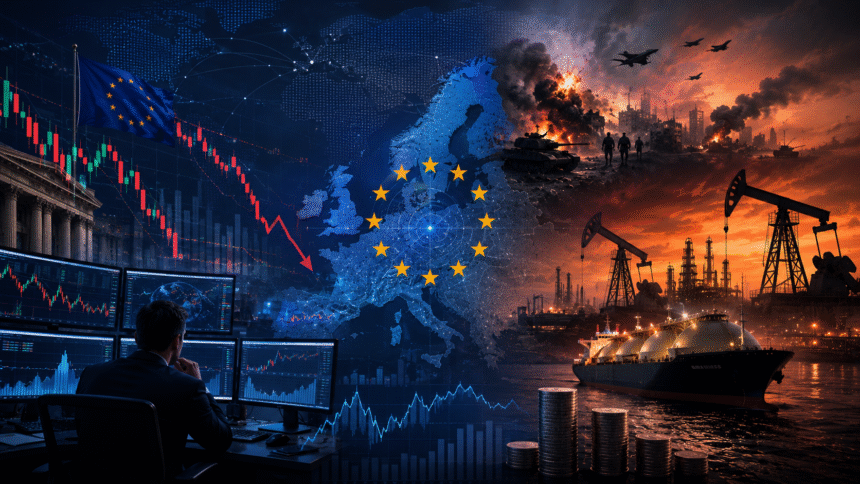
European financial markets continue to closely monitor escalating geopolitical tensions in the Middle East and the ongoing war in Ukraine, as investors and policymakers grow increasingly concerned about the potential impact on economic growth, energy prices, and financial stability across the continent.
Major European stock indexes experienced cautious trading amid uncertainty surrounding global energy supplies and fears of prolonged instability in key geopolitical regions. Analysts say investors remain highly sensitive to developments that could disrupt oil and gas markets or weaken industrial activity within Europe.
The conflict in Ukraine continues to place pressure on European economies, particularly through energy costs, defense spending, and supply chain disruptions. Although Europe has reduced its dependence on Russian energy since the start of the war, concerns remain over potential shortages and price volatility, especially during periods of heightened military escalation.
At the same time, rising tensions in the Middle East have added further uncertainty to global markets. Investors fear that any major disruption to shipping routes, oil exports, or regional stability could trigger another surge in energy prices, potentially increasing inflationary pressures across Europe at a time when many economies are already struggling with weak growth.
Several European financial institutions and economic research groups have warned that economic growth across the eurozone could slow significantly in 2026 if geopolitical tensions continue to intensify. Manufacturing activity in some countries has already shown signs of weakening, while consumer spending remains under pressure from high living costs and elevated borrowing rates.
Energy markets remain one of the main areas of concern for European governments and businesses. Despite efforts to diversify supply sources and invest in renewable energy infrastructure, Europe remains vulnerable to sudden global price fluctuations caused by conflicts or supply disruptions.
Central banks across Europe are also facing a difficult balancing act between controlling inflation and supporting economic growth. Economists warn that prolonged geopolitical instability could complicate monetary policy decisions and increase the risk of stagnation in several European economies.
Meanwhile, defense spending and security concerns are increasingly influencing market behavior. Governments across Europe continue expanding military budgets and emergency preparedness programs, reflecting growing fears that geopolitical tensions may persist for years rather than months.
Despite the uncertainty, some analysts believe European markets remain relatively resilient due to stronger energy reserves, improved diversification strategies, and continued government support measures introduced after previous energy crises. However, investors remain cautious as global geopolitical risks continue to evolve rapidly.
Market observers say the coming months will likely be critical in determining whether Europe can avoid a deeper economic slowdown while navigating one of the most complex geopolitical environments in recent decades.