

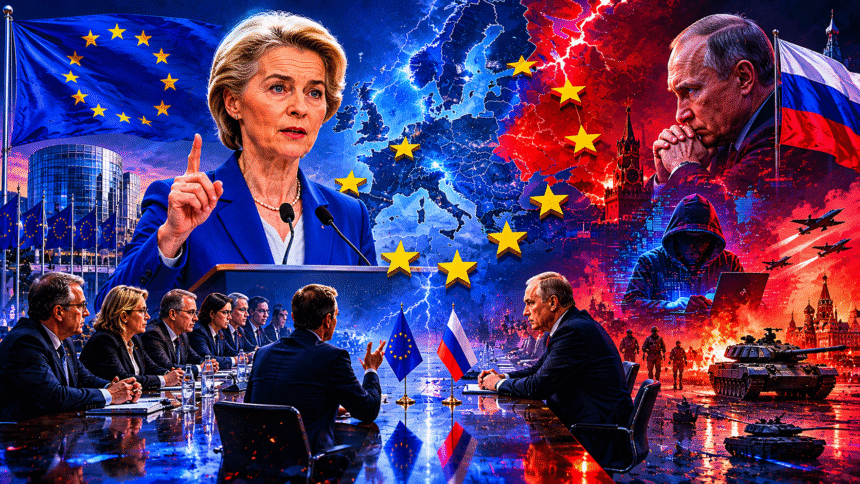
European tensions with Moscow escalated further after European Commission President Ursula von der Leyen accused Russia of attempting to “destabilize Europe” amid the ongoing war in Ukraine and rising security concerns across the continent.
Speaking during a regional security discussion, von der Leyen warned that Europe is facing what she described as increasing hybrid threats linked to Moscow, including political pressure, cyber activities, disinformation campaigns, and actions aimed at undermining stability within European states.
“Europe must remain united and vigilant against attempts to weaken our institutions and destabilize our societies,” von der Leyen said, emphasizing that the conflict in Ukraine has expanded beyond the battlefield into broader geopolitical and security challenges affecting the entire region.
The remarks came as several European countries summoned Russian ambassadors following what officials described as threats and escalating rhetoric connected to the war in Ukraine.
Diplomatic tensions have intensified in recent weeks as European governments accuse Moscow of increasing pressure tactics against countries supporting Ukraine militarily and financially. Several capitals across Eastern and Northern Europe have expressed growing concerns over security risks near NATO territory and alleged interference efforts targeting European political systems.
European officials said the summoning of Russian diplomats was intended to deliver formal protests and demand clarification regarding statements and actions viewed as threatening regional security and diplomatic stability.
Russia has repeatedly denied accusations of attempting to destabilize Europe and has instead accused Western governments of escalating tensions through military aid and political support for Ukraine.
The latest diplomatic confrontation highlights the widening divide between Russia and European institutions more than four years after the war in Ukraine fundamentally reshaped Europe’s political and security landscape.
Security analysts say European governments are increasingly concerned about hybrid warfare tactics, including cyberattacks, energy pressure, propaganda campaigns, and attempts to influence elections and public opinion within EU member states.
NATO and European Union officials have both accelerated efforts to strengthen regional defense coordination, cybersecurity protections, and intelligence sharing in response to what they describe as evolving security threats linked to the conflict.
Several European countries bordering Russia and Belarus have also expanded military readiness measures and increased surveillance along sensitive border regions over the past year.
Despite ongoing tensions, European leaders insist they remain committed to supporting Ukraine politically, economically, and militarily while seeking to prevent broader instability across the continent.
The growing diplomatic friction underscores how the war in Ukraine continues to reshape Europe’s strategic priorities, with security, defense, and geopolitical resilience now dominating the agenda of many European governments.