


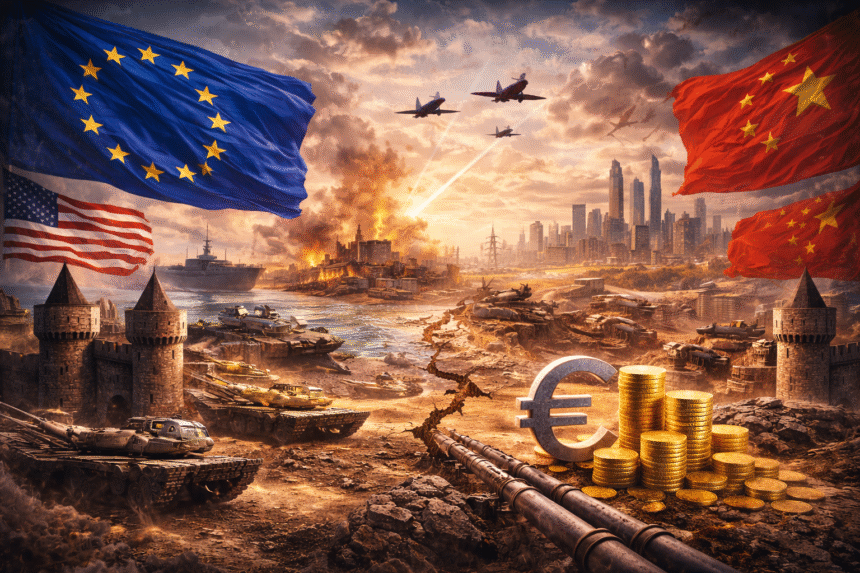
As the war in Ukraine continues with no clear end in sight, European leaders are accelerating efforts to strengthen the continent’s defensive and economic sovereignty, navigating growing pressures not only from Russia but also from strategic challenges posed by both the United States and China.
Nearly four years into the conflict, Europe remains a central supporter of Ukraine militarily, financially, and politically. However, the prolonged war has exposed structural vulnerabilities within the European Union — particularly in defense capabilities, energy security, industrial capacity, and strategic autonomy.
Defense Independence Gains Urgency
The war has reinforced concerns among EU leaders about Europe’s heavy reliance on U.S. military support through NATO. While transatlantic cooperation remains a cornerstone of European security, recent political uncertainty in Washington has renewed calls for Europe to develop a stronger, more independent defense posture.
EU member states have increased defense spending, expanded joint weapons procurement, and revived discussions around a stronger European defense industry. Officials stress that the goal is not to weaken NATO, but to ensure Europe can act decisively if U.S. priorities shift or global crises multiply.
Economic Sovereignty and Strategic Competition
Alongside defense, economic sovereignty has become a central priority. Europe faces growing competition from China’s state-backed industries and increasing trade and industrial pressure from the United States, particularly through subsidies and protectionist measures tied to strategic sectors such as green technology, semiconductors, and electric vehicles.
In response, the EU has rolled out industrial policies aimed at protecting critical supply chains, boosting domestic manufacturing, and reducing dependency on external powers. The bloc’s strategy emphasizes “de-risking” rather than decoupling — especially with China — while seeking fairer trade conditions with both Beijing and Washington.
Energy, Industry, and the Cost of War
The Ukraine war has also reshaped Europe’s energy landscape. The rapid reduction of Russian energy imports forced European economies to adapt at high cost, accelerating the transition toward renewable energy while exposing inflationary pressures and industrial competitiveness challenges.
European policymakers now view energy independence as a pillar of national security, linking economic resilience directly to geopolitical stability.
A Defining Moment for Europe
As global power competition intensifies, Europe is positioning itself as a more autonomous geopolitical actor — one that remains allied with the United States, economically engaged with China, and firmly opposed to Russia’s actions in Ukraine.
EU officials acknowledge that balancing these relationships will be one of the defining challenges of the coming decade. The war in Ukraine, they argue, has made one reality clear: Europe can no longer rely solely on external powers to safeguard its security, economy, and strategic future.