

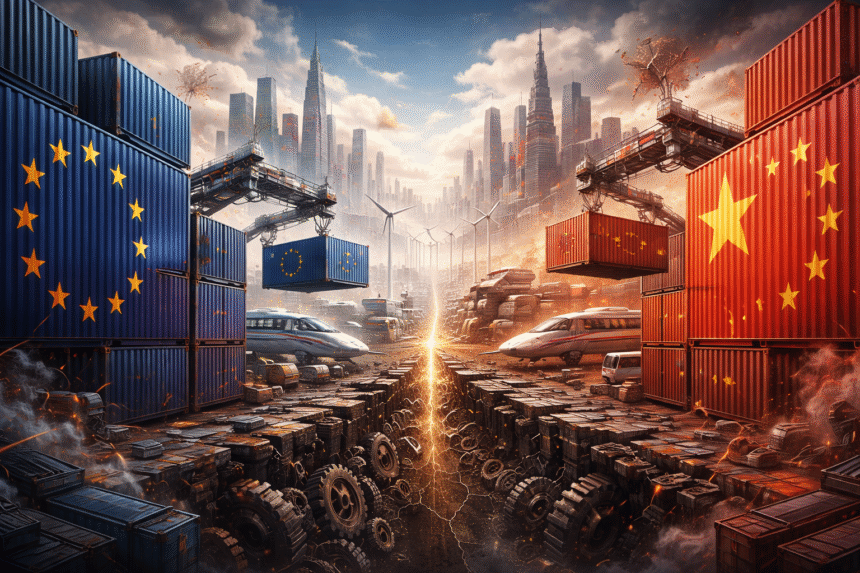
The European Union’s foreign policy chief has warned that China represents a long-term economic challenge for Europe, underscoring growing concerns in Brussels about trade imbalances, industrial competition, and strategic dependencies.
Speaking during recent discussions with EU foreign ministers, the EU’s High Representative for Foreign Affairs and Security Policy said that while China remains an important global economic partner, its state-driven economic model and expanding industrial capacity pose structural risks to European industries and economic security.
The official stressed that Europe’s challenge with China is not a short-term dispute but a systemic issue that will shape EU economic and foreign policy for years to come. Key areas of concern include overcapacity in Chinese manufacturing, particularly in sectors such as electric vehicles, steel, renewable energy equipment, and advanced technologies.
Trade Imbalances and Industrial Pressure
EU officials argue that Chinese companies often benefit from heavy state subsidies, preferential financing, and limited market access for foreign competitors — creating what Brussels views as an uneven playing field. European manufacturers, in contrast, face stricter regulatory standards and limited access to the Chinese market.
“These imbalances threaten Europe’s industrial base if left unaddressed,” the foreign policy chief said, adding that the EU must protect its strategic industries while remaining committed to open and fair trade.
From Dependence to ‘De-Risking’
The comments align with the EU’s broader strategy of “de-risking, not decoupling” from China. Rather than severing economic ties, the bloc aims to reduce excessive dependence on Chinese supply chains in critical sectors such as rare earths, batteries, semiconductors, and pharmaceuticals.
Brussels has already introduced a series of defensive trade instruments, including foreign subsidy investigations, tighter investment screening mechanisms, and measures to counter economic coercion.
Balancing Competition and Cooperation
Despite the warning, EU leaders emphasize that China remains a crucial partner on global issues such as climate change, global health, and financial stability. However, the foreign policy chief noted that cooperation must be balanced with clear limits when European economic sovereignty is at risk.
The remarks come amid broader geopolitical shifts, as Europe seeks to strengthen its strategic autonomy while navigating complex relationships with both the United States and China.
As global economic competition intensifies, the EU’s leadership signaled that managing relations with Beijing will be one of Europe’s defining economic and strategic challenges of the coming decade.