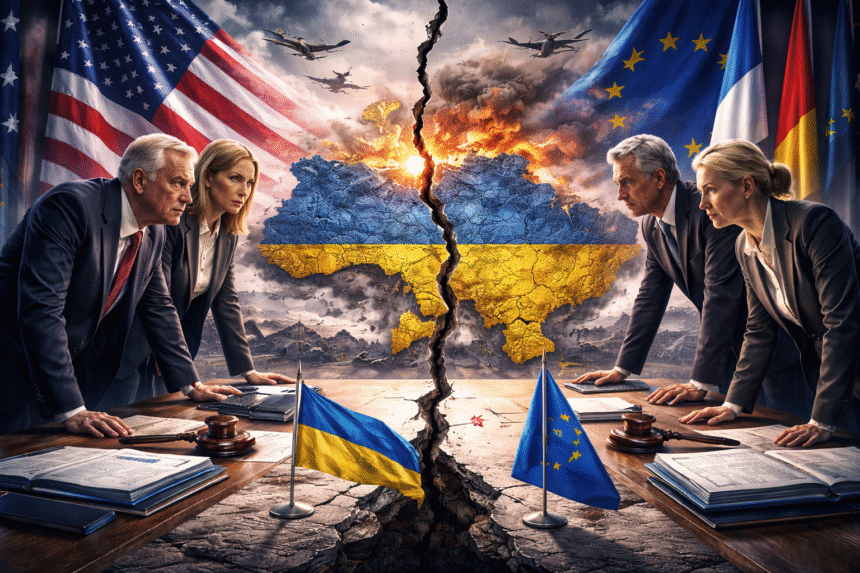
Diplomatic friction is growing between the United States and the European Union over the future of the war in Ukraine, with both sides expressing divergent views on proposed peace agreements and the path to ending nearly four years of conflict.
At the heart of the dispute are differing priorities on how to structure a peace settlement that both stops the fighting and secures Ukraine’s long-term sovereignty.
U.S. Peace Plan Faces European Skepticism
The United States has been actively promoting a 28-point peace plan aimed at ending the war by late 2025, developed under the direction of U.S. officials and backed by President Donald Trump. The U.S. framework includes provisions for security guarantees and controversial elements such as potential territorial arrangements in the contested eastern regions and restrictions on the size of Ukraine’s armed forces.
However, many European leaders — particularly in Brussels, Paris, and Berlin — have been critical of elements of the U.S. proposal, arguing that it may force Ukraine into concessions that undermine its sovereignty or amount to a reward for Russian aggression. European officials have pushed back against terms perceived as requiring Kyiv to cede control of territory or limit its military capabilities.
In response, the European Union has drafted its own counter-proposal, retaining more robust security guarantees and rejecting strict limits on Ukraine’s future military strength. The EU version also emphasizes negotiations over contested territories based on current front lines, rather than pre-set concessions.
Points of Contention
Several key disagreements illustrate the diplomatic gap:
- Security Guarantees: Brussels wants strong and long-term guarantees for Ukraine’s defense, whereas some U.S. proposals have included constraints on Ukraine’s military posture in any post-war settlement.
- Territorial Integrity: European leaders insist any peace deal must affirm Ukraine’s territorial claims and avoid formal acceptance of Russian control over occupied areas, while U.S. negotiators have explored compromise formulas that critics say may weaken Ukraine’s position.
- Role in Negotiations: Many European officials have voiced concern that initial U.S. efforts sidelined European partners in key drafting phases, complicating transatlantic coordination on a unified peace strategy.
Political and Strategic Stakes
The dispute reflects broader transatlantic tensions over how to achieve a “just and lasting peace” in Ukraine without emboldening Russia or weakening NATO’s deterrence. European Commission President Ursula von der Leyen has emphasized that the focus should remain on ensuring Moscow demonstrates a genuine commitment to peace, and that the agreement must not incentivize further Russian aggression.
Meanwhile, contrasting public statements from U.S. leaders — including claims that Ukrainian President Volodymyr Zelensky is slowing progress on peace talks — have further unsettled European allies, who maintain that Russia bears responsibility for obstruction and continued hostilities.
Looking Ahead
Diplomats in Brussels and Washington say ongoing negotiations are likely to require more high-level discussions and compromises if a broadly acceptable peace framework is to emerge. Both sides agree on the broad objective of ending the war, but the precise terms of how that peace is structured — and what guarantees it offers — remain deeply contested.
As winter turns to spring, transatlantic policymakers will be under increasing pressure to reconcile differences and present a united front that both supports Ukraine and deters further Russian expansionism on the European continent.