


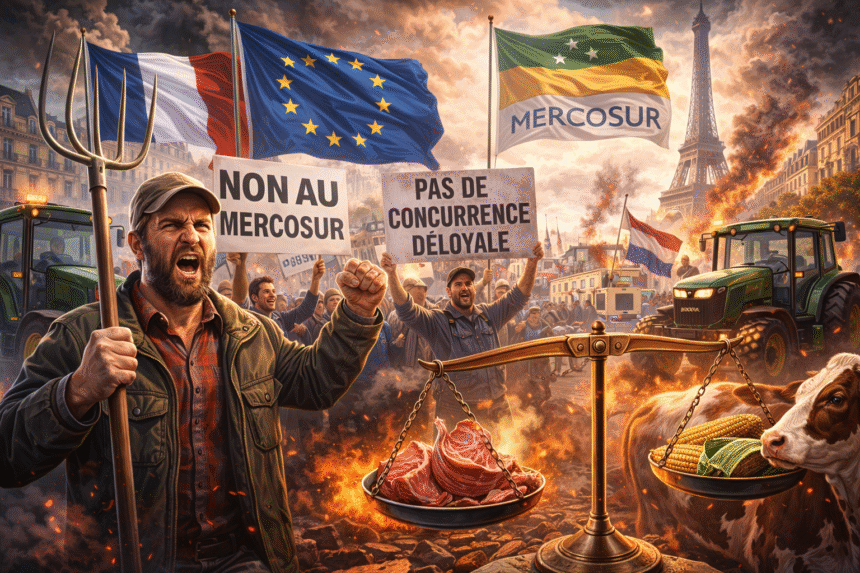
Thousands of farmers took to the streets of Paris to protest against the proposed EU-Mercosur trade agreement, warning that the deal could severely undermine European agriculture by exposing it to what they describe as unfair competition from South American producers.
Demonstrators, many arriving with tractors and farm vehicles, blocked major roads and gathered near government buildings, carrying banners denouncing the agreement. Farmers’ unions argue that agricultural imports from Mercosur countries—Brazil, Argentina, Uruguay, and Paraguay—would be produced under lower environmental, labor, and animal-welfare standards, putting European farmers at a competitive disadvantage.
Protest leaders say the deal threatens livelihoods across France’s rural regions. “European farmers are being asked to meet strict rules on sustainability, pesticides, and animal welfare, while imports would not face the same obligations,” one union representative said. “This is not free trade—it is unfair trade.”
At the heart of the dispute is concern over increased imports of beef, poultry, sugar, and soy, sectors that French farmers say are particularly vulnerable. Producers fear that cheaper imports could flood EU markets, drive down prices, and accelerate the decline of small and medium-sized farms already under pressure from rising costs and climate challenges.
The French government has acknowledged the farmers’ concerns and reiterated that it will not support the agreement unless it includes strong safeguards for European agriculture. Paris has repeatedly called for enforceable clauses on environmental protection, traceability, and reciprocity of standards.
The European Commission, meanwhile, argues that the EU-Mercosur deal would create one of the world’s largest free-trade zones, benefiting European exporters in sectors such as manufacturing, services, and green technology. However, officials admit that the agreement remains politically sensitive and faces resistance from several member states.
The protests in Paris reflect broader opposition across Europe, with similar demonstrations having taken place in other countries. As negotiations continue, farmers are warning that without concrete protections, the trade deal risks deepening rural discontent and fueling further protests across the continent.