

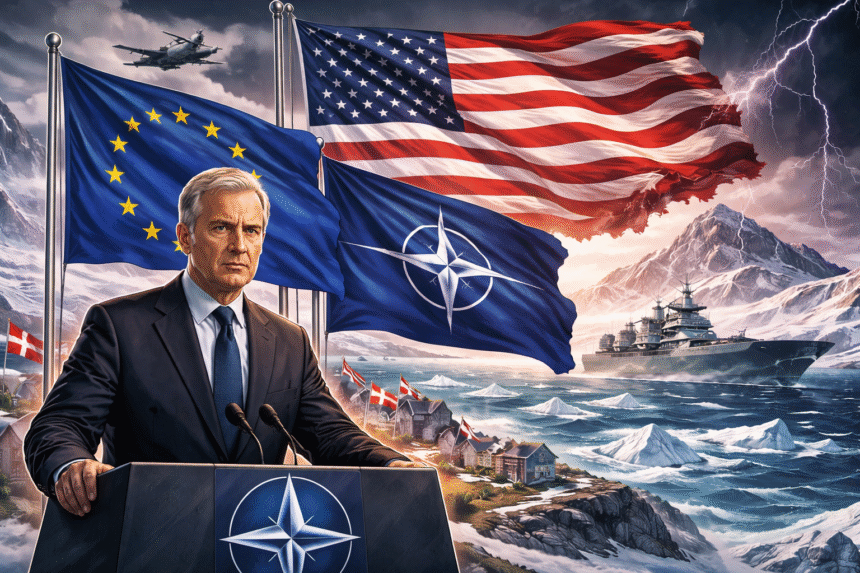
A senior European official has issued a stark warning, describing recent U.S. plans and rhetoric regarding Greenland as an “existential threat” to NATO, amid growing unease in Europe over Washington’s approach to the strategically vital Arctic island.
The comments reflect mounting concern within European political and security circles that unilateral American moves toward Greenland could undermine alliance cohesion, strain transatlantic trust, and destabilize the carefully balanced security architecture of the North Atlantic region.
According to the official, Greenland’s status is not merely a bilateral issue between the United States and Denmark, but a core NATO matter. “Any attempt to impose control, bypass allies, or redefine sovereignty without consensus strikes at the heart of the alliance,” the official said, emphasizing that NATO is built on collective decision-making and respect for member states’ territorial integrity.
Greenland, an autonomous territory within the Kingdom of Denmark, occupies a critical geostrategic position between North America and Europe. It hosts key early-warning systems and military infrastructure essential to NATO’s Arctic defense posture. While the United States already maintains a military presence on the island, European officials fear that expanded ambitions framed outside NATO structures could fracture alliance unity at a time of heightened global tensions.
The warning also highlights broader European anxiety about unpredictability in U.S. foreign policy. Diplomats note that aggressive or transactional approaches toward allies risk weakening NATO’s credibility, particularly as the alliance faces simultaneous challenges from Russia in Eastern Europe and increasing Chinese activity in the Arctic.
Denmark has consistently reaffirmed that Greenland’s future can only be determined by its people, within the existing constitutional framework. Greenlandic leaders have likewise rejected any notion of foreign control, stressing cooperation over confrontation and reiterating their commitment to NATO through Denmark.
Security analysts argue that framing Greenland as a geopolitical prize rather than a partner undermines NATO’s core principle of collective defense. “If allies begin to view each other as competitors instead of partners, NATO’s deterrence power erodes from within,” one European defense expert said.
As Arctic geopolitics intensify due to climate change, resource competition, and new shipping routes, European leaders are calling for a unified NATO strategy that respects sovereignty while strengthening collective security. The message from Brussels and other European capitals is clear: Greenland must remain a pillar of cooperation—not a flashpoint that threatens the alliance’s very existence.