

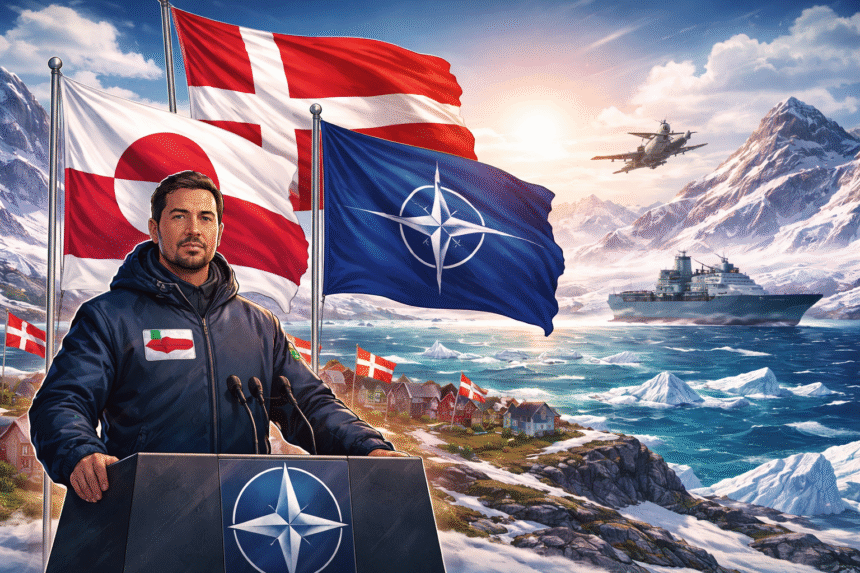
The Prime Minister of Greenland has firmly rejected any notion of American control over the Arctic island, stressing that Greenland “is not for sale” and will continue to remain within the Kingdom of Denmark and under the security umbrella of NATO. The statement comes amid renewed tensions with the United States over Greenland’s strategic position and growing geopolitical importance in the Arctic.
Speaking to local and international media, the Prime Minister emphasized that Greenland’s future is determined solely by its people, reaffirming the island’s commitment to its current political status while pursuing greater autonomy through democratic means. “Greenland is not a commodity and cannot be traded or controlled by external powers,” he said, adding that cooperation with international partners must be based on mutual respect and sovereignty.
The remarks follow increased American interest in the Arctic region, driven by competition with Russia and China over shipping routes, natural resources, and military positioning as climate change accelerates ice melt. While the United States already maintains a military presence at Thule Air Base in northwestern Greenland, recent political rhetoric in Washington has revived concerns in Nuuk and Copenhagen about potential overreach.
Denmark welcomed the Prime Minister’s comments, reiterating its support for Greenland’s right to self-determination within the Danish realm. Danish officials underlined that Greenland’s security is closely tied to NATO and transatlantic cooperation, but insisted that this does not equate to foreign control over the island’s political future.
Analysts say Greenland’s stance reflects a broader European effort to assert sovereignty and unity in the face of shifting U.S. foreign policy signals. The issue has also resonated within the European Union and NATO, where Greenland is increasingly viewed as a key strategic node in Arctic defense and global security.
For Greenland, the message is clear: while the island remains open to cooperation and investment, especially in areas such as infrastructure, climate research, and sustainable development, its political status is non-negotiable. As Arctic geopolitics intensify, Nuuk is seeking to balance its relationships carefully—anchored to Denmark and NATO, while firmly rejecting any narrative that treats the island as an asset to be bought or controlled.