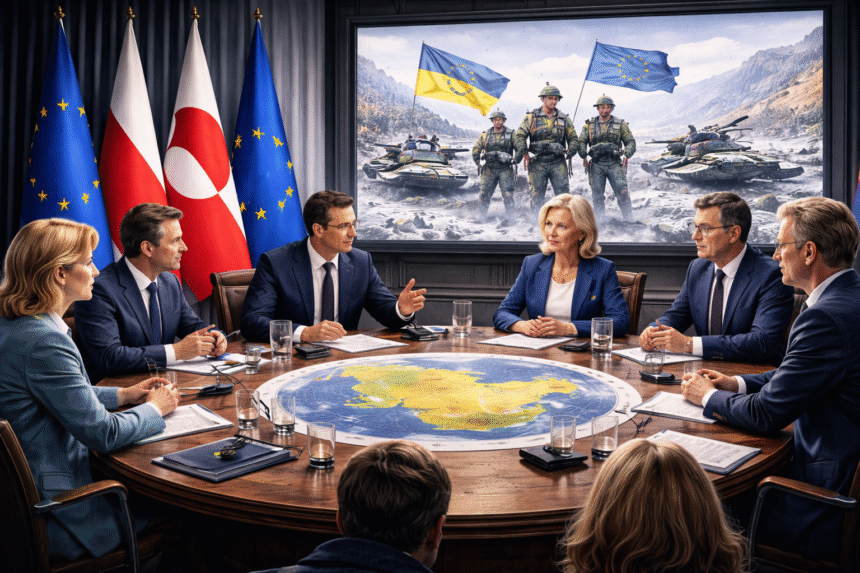
European debates over security and geopolitical responsibility intensified this week, as leaders voiced support for stronger security guarantees for Ukraine — while Poland renewed calls for deeper European solidarity in the face of mounting international challenges.
The developments reflect growing recognition that Europe must prepare for prolonged instability around its borders, even as internal disagreements persist over how far the continent should go in providing military and political backing.
Security Guarantees for Ukraine Gain Momentum
Several European governments signaled readiness to advance long-term security commitments for Ukraine, extending beyond immediate battlefield aid.
These guarantees may include:
- sustained military assistance and training
- cooperation on air defense and intelligence
- commitments to help rebuild Ukraine’s defense industry
- closer integration with European security frameworks
Officials emphasized that such guarantees are not a substitute for NATO membership, but rather a practical bridge to ensure Ukraine can defend itself while political discussions continue.
“Ukraine must never again be left exposed,” one senior EU diplomat said. “Security guarantees are part of ensuring that aggression is not rewarded — and not repeated.”
Poland’s Message: Europe Must Stand Together
Poland has emerged as one of the loudest advocates for stronger collective action.
Warsaw argues that Europe faces a historic moment, from the war in Ukraine to energy pressures, border security, and potential global power shifts.
Polish leaders are urging:
- greater burden-sharing among EU states
- cohesive responses to migration, defense, and sanctions
- tighter coordination with NATO allies
- faster decision-making within EU institutions
They warn that divisions or hesitation could embolden external adversaries and weaken Europe’s credibility.
“Solidarity cannot be a slogan — it must be a policy,” Poland’s leadership stressed. “Europe must act as one.”
Unity — With Friction
While there is broad agreement on supporting Ukraine, debates continue over:
- long-term financing mechanisms
- the balance between diplomacy and deterrence
- differing levels of public support across member states
Some Western European governments favor cautious, diplomatic approaches, while nations along NATO’s eastern flank — including Poland and the Baltic states — push for firmer guarantees and faster implementation.
Strategic Stakes for Europe
Analysts warn that how Europe handles these issues will shape its global role for years to come.
Key questions ahead:
- Can Europe coordinate sustained military support without overstretch?
- Will security guarantees deter aggression — or escalate tensions?
- Can EU unity hold under economic and political pressure?
For now, leaders insist that defending Ukraine and reinforcing solidarity are not separate goals, but intertwined priorities essential for stability.
“Europe’s security begins with Ukraine,” one analyst noted, “and Europe’s strength depends on whether it stands together.”