


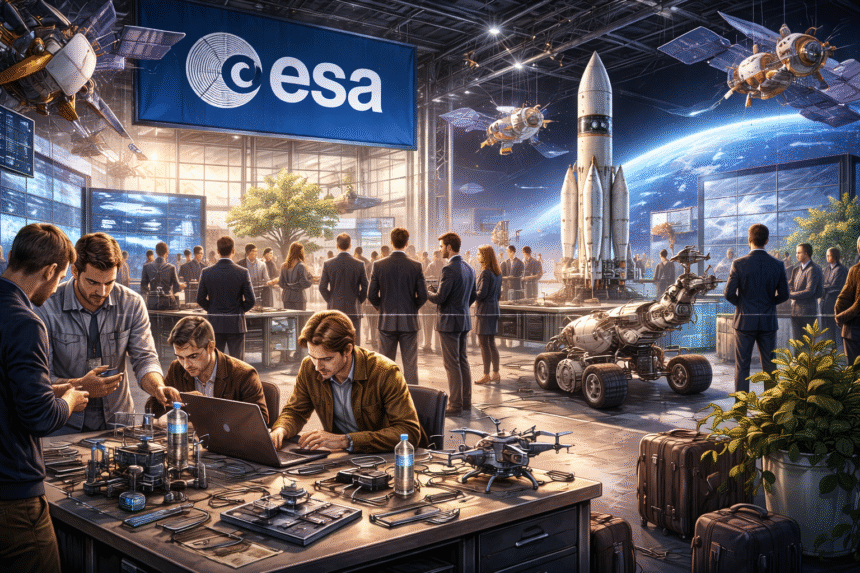
The European Space Agency (ESA) is taking on a growing role in supporting startups and accelerating technological innovation, positioning Europe as a competitive force in the rapidly evolving global space economy.
With private space investment expanding worldwide — led by companies in the United States and Asia — ESA is shifting from a purely institutional agency into a strategic partner for entrepreneurs, offering funding, technical expertise, testing facilities, and access to satellite data.
From Exploration to Entrepreneurship
Historically focused on missions, satellites, and scientific research, ESA now invests heavily in programs that help startups transform ideas into market-ready solutions. Through its network of Business Incubation Centres (BICs) across Europe, the agency supports hundreds of early-stage companies each year.
These startups work in fields ranging from:
- satellite-based climate monitoring
- precision agriculture
- autonomous transport systems
- disaster response tools
- secure communications and cybersecurity
Many rely on ESA’s Earth-observation platforms and navigation technologies as core elements of their products.
Navigating Commercial — and Geopolitical — Pressure
ESA’s transformation comes at a time of mounting commercial competition and geopolitical tensions in space. The rise of mega-constellations, reliance on non-European launch providers, and tightening export controls have underscored the need for European resilience and technological independence.
Officials say supporting startups is not just about innovation — it is also about strategic sovereignty.
“A strong startup ecosystem helps Europe stay competitive, reduce dependency, and ensure we control critical space infrastructure,” one ESA official noted.
Public Investment Meets Private Ambition
ESA continues to leverage partnerships with European governments, the European Union, and private funds to de-risk early technologies that commercial investors might otherwise avoid. Once proven, these technologies often attract significant private capital.
The agency also works closely with industries such as telecommunications, climate technology, mobility, and defense — helping translate space research into real-world economic impact.
A Focus on Sustainability and Dual-Use Tech
New ESA programs emphasize:
- green propulsion systems
- reusable launch technologies
- climate-monitoring satellites
- dual-use technologies applicable to both civilian and security sectors
This approach reflects growing recognition that space infrastructure is now critical to energy networks, communications, trade, and national security.
Looking Ahead
Analysts say ESA’s startup-focused strategy could help Europe carve out stronger positions in emerging markets such as space-based internet, orbital manufacturing, and planetary observation services.
But challenges remain: budget constraints, launch costs, and competition from tech giants mean ESA must continue balancing long-term space exploration with short-term commercial needs.
For Europe’s new generation of entrepreneurs, however, one thing is clear — ESA is no longer just a gateway to space science. It is becoming a central engine of innovation, investment, and opportunity.