

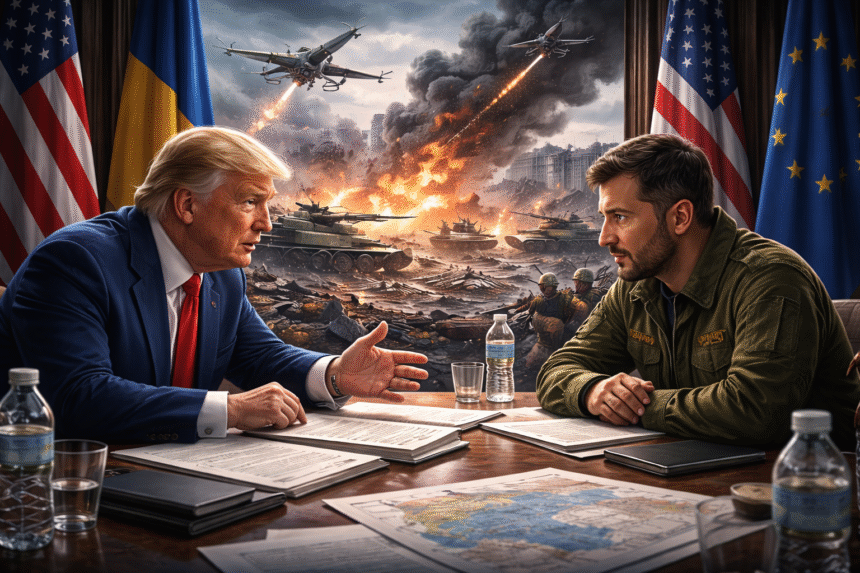
Efforts to explore a pathway to peace between Ukraine and Russia faced immediate strain as drone strikes and military clashes continued across Ukrainian territory, even as former U.S. President Donald Trump held high-profile discussions with Ukrainian President Volodymyr Zelensky.
The talks — framed as exploratory and unofficial — aimed to assess whether conditions exist for a ceasefire or broader negotiations. Yet events on the ground highlighted how fragile and complex the conflict remains.
Violence overshadows diplomacy
Ukrainian officials reported multiple drone and missile attacks targeting energy infrastructure and residential districts in several regions. Emergency crews were deployed to extinguish fires and restore electricity in affected areas. Casualties were reported, though numbers remained under assessment.
“Every strike during peace discussions sends a message,” a Ukrainian security adviser said. “Russia wants leverage at the negotiating table — and it uses the battlefield to obtain it.”
Moscow, meanwhile, accused Ukraine of launching cross-border drone operations and insisted that its own strikes were “defensive” and aimed at military targets — claims Kyiv strongly disputes.
Trump positions himself as a mediator
Trump has repeatedly argued he could help broker an end to the war, portraying himself as a pragmatic negotiator capable of speaking to both Kyiv and Moscow. Supporters say his involvement could revive stalled diplomacy; critics warn that premature concessions could leave Ukraine vulnerable.
Zelensky, while open to dialogue, reiterated that peace must be based on sovereignty, territorial integrity, and security guarantees.
“We cannot call occupation ‘peace,’” Zelensky told reporters. “Negotiations must stop the war — not freeze it.”
Allies watch cautiously
European governments reacted cautiously, welcoming any serious diplomatic initiative but stressing that Ukraine’s leadership must determine the terms of any settlement.
NATO officials warned that continued drone warfare and long-range strikes risk accidental escalation, especially near borders and critical infrastructure.
Humanitarian organizations also expressed concern, noting that renewed attacks coincide with already strained housing, health, and energy systems.
No quick breakthrough in sight
Analysts say the simultaneous pursuit of battlefield advantage and diplomatic leverage makes rapid progress unlikely.
“Both sides still believe time can improve their position,” one regional expert said. “Talks are happening — but the war is still speaking louder.”
For civilians, the contrast is stark: while leaders sit around negotiation tables, sirens, explosions, and evacuations continue to define daily life across parts of Ukraine.
As discussions resume in the coming weeks, diplomats acknowledge an uncomfortable truth — peace remains an objective, but the path toward it is neither linear nor guaranteed.