


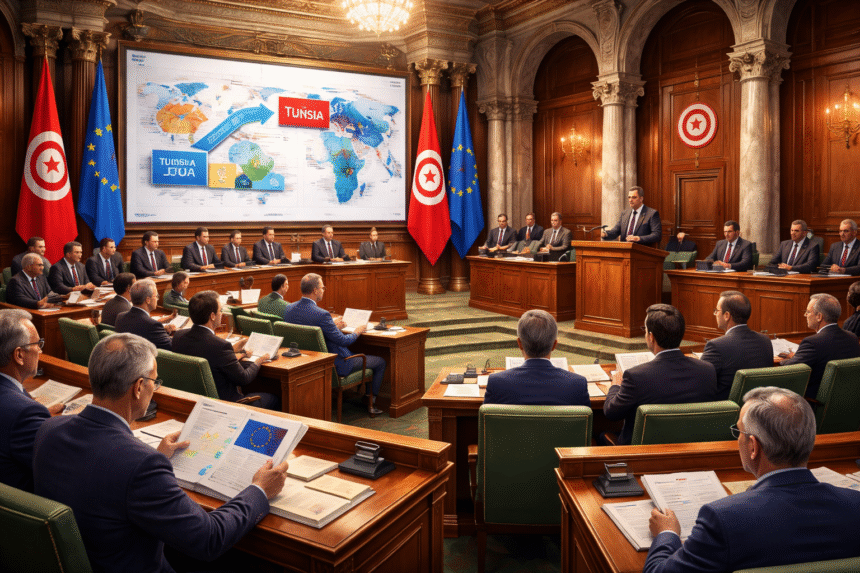
The Tunisian parliament has begun deliberations on possible amendments to the country’s partnership and free-trade agreements with European Union member states, amid growing debate over economic sovereignty, market access, and the protection of strategic local industries.
During a special session, lawmakers listened to the Minister of Trade and Export Development, who outlined the government’s approach to reassessing sections of the agreements that Tunisia considers outdated or misaligned with current economic realities.
Focus on balanced trade and domestic protection
Several members of parliament argued that while Tunisia values its historic partnership with Europe — its largest trading partner — the country must seek “fair and balanced” terms that help narrow structural trade deficits and support national development.
Parliamentarians emphasized three key priorities:
- protecting sensitive sectors such as agriculture and small manufacturing,
- encouraging greater local production and value-added industries, and
- reducing dependence on imported goods that compete with Tunisian producers.
Others called for safeguards to protect workers, fair competition rules, and clearer mechanisms to address market disruptions.
Trade ministry: revision aims to modernize agreements
The Trade Minister stressed that the discussions should not be seen as confrontational toward Brussels, but as part of a technical and strategic review intended to modernize agreements signed years earlier.
According to the ministry, the review will consider:
- revising tariff structures on strategic imports and exports,
- promoting technology transfer and investment partnerships,
- ensuring transparency and standards compliance across both sides, and
- strengthening support measures for small and medium enterprises.
The minister also confirmed that consultations will involve business organizations, unions, farmers’ groups, and civil society to ensure wide participation in shaping any proposals.
Europe remains Tunisia’s main economic partner
The European Union absorbs a significant share of Tunisia’s exports — including textiles, mechanical components, and agri-food products — and remains a major investor and donor. European officials have previously encouraged Tunisia’s reform efforts while urging predictability in economic policy.
Economists note that Tunisia faces a delicate balancing act: maintaining privileged access to European markets while addressing domestic pressures for greater protection and industrial revival.
Next steps
Parliamentary committees will continue reviewing sector-specific proposals before the government enters any formal negotiations with EU counterparts. Any amendments, officials noted, would likely be implemented gradually to avoid disrupting existing trade flows.
For Tunisia, the debate signals a broader question — how to leverage international partnerships while ensuring they contribute more directly to growth, employment, and long-