


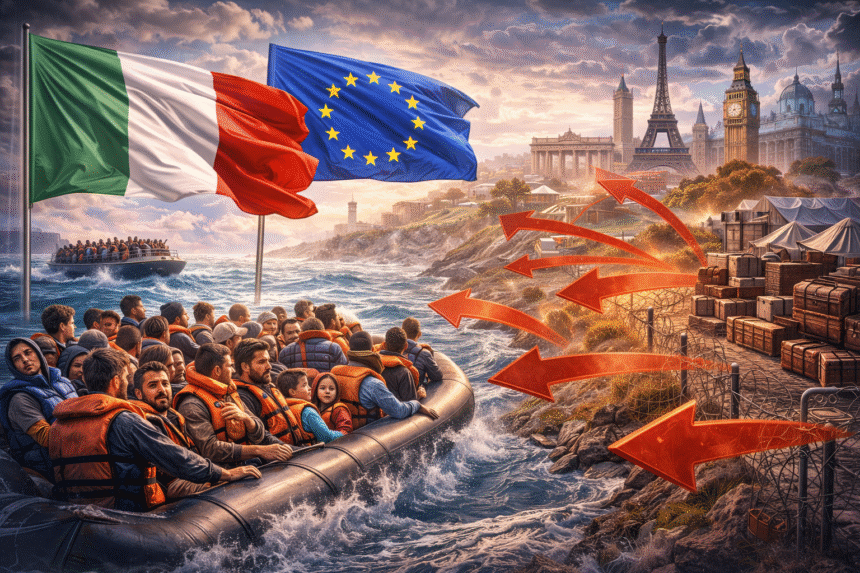
The migration issue has returned to the forefront of European debate after the Italian government called for a wider and more equitable distribution of migrants across the European Union, warning that continued inaction could place unsustainable pressure on southern coastal states.
Italian officials stressed that frontline countries, particularly those along the Mediterranean, are bearing a disproportionate burden as arrivals continue via sea routes from North Africa. Rome argues that without a fair redistribution mechanism, countries such as Italy, Greece, and Spain will remain overstretched in terms of reception capacity, border management, and humanitarian response.
The Italian government urged EU partners to accelerate the implementation of shared responsibility frameworks, including relocation quotas, stronger solidarity mechanisms, and increased financial and logistical support. Officials warned that failure to act collectively risks worsening humanitarian conditions and fueling political and social tensions in coastal regions.
The renewed call comes amid ongoing divisions within the EU over migration policy. While some member states support deeper cooperation and burden-sharing, others remain reluctant to accept mandatory relocation schemes, citing domestic political concerns and capacity limits.
European institutions have acknowledged the pressure on southern borders and reiterated the need for a comprehensive approach combining border management, asylum reform, cooperation with origin and transit countries, and fair internal distribution. However, progress has remained slow, with key elements of the EU migration pact still contested.
As arrivals continue and weather conditions improve for sea crossings, Italy has warned that the coming months could bring increased migration flows, making EU-wide coordination more urgent than ever. The issue is expected to feature prominently in upcoming European meetings, as leaders seek to balance humanitarian obligations with political realities across the bloc.