

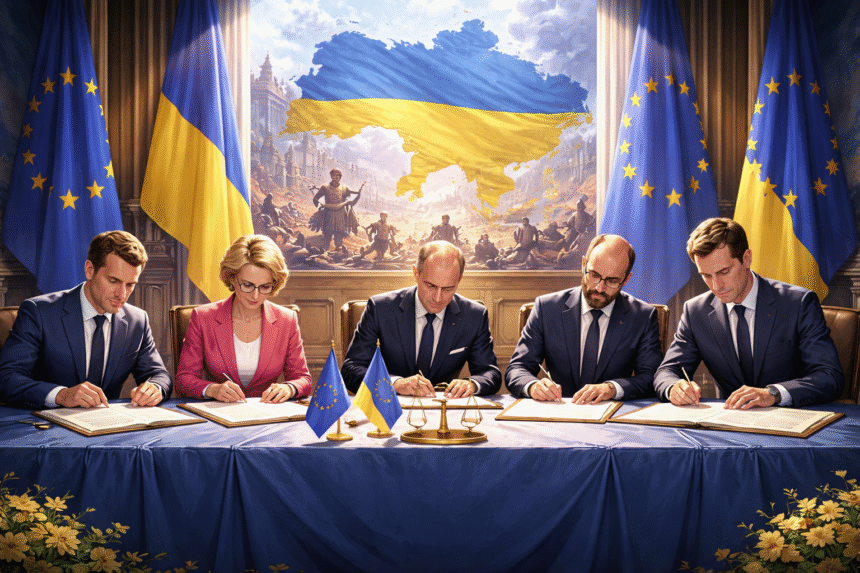
European leaders have signed a landmark treaty establishing a War Damages Committee for Ukraine, a new international body tasked with documenting destruction, assessing losses, and pursuing compensation from Russia for damages caused by the ongoing war. The agreement was finalized during high-level meetings in Europe, held alongside continued diplomatic efforts aimed at ending the conflict.
The treaty represents a significant legal and political step by Europe, signaling that accountability for the war’s consequences will move forward in parallel with peace negotiations, not after them. Officials involved stressed that justice and reconstruction cannot be postponed until the guns fall silent.
Mandate and Objectives
The newly created committee will be responsible for:
- Collecting and verifying evidence of physical, economic, and environmental damage across Ukraine
- Registering claims submitted by the Ukrainian state, businesses, and civilians
- Preparing legal groundwork for future compensation mechanisms
- Coordinating with international courts, institutions, and partner governments
European officials described the body as a foundational pillar for future reparations, even if actual payments take years to materialize.
Frozen Russian Assets at the Center of Debate
While the treaty itself does not authorize immediate seizures, European leaders openly acknowledged that frozen Russian assets—estimated at over €200 billion globally, much of it held in Europe—remain central to discussions about compensation.
Several EU states argued that the legal architecture being built now is essential to justify any future use of those assets for Ukraine’s reconstruction, while others urged caution to avoid setting precedents that could destabilize international financial systems.
Peace Talks Continue Alongside Accountability
The signing comes as diplomatic channels remain active, with European, American, and Ukrainian officials continuing negotiations aimed at achieving a ceasefire or political settlement. Leaders emphasized that pursuing war damages does not undermine peace talks, but rather reinforces the principle that aggression carries consequences.
“This is not an obstacle to peace,” one European diplomat said. “It is a message that peace cannot be built on impunity.”
A Signal to Moscow and the World
For Ukraine, the treaty is a symbolic and strategic victory—affirming international recognition of the harm suffered and strengthening its position in future negotiations. For Europe, it reflects a broader shift toward long-term responsibility and rule-based accountability in response to large-scale wars.
Although Russia has rejected all responsibility and dismissed compensation claims, European leaders made clear that the process will continue regardless of Moscow’s stance.
Looking Ahead
The War Damages Committee is expected to begin operations in the coming months, starting with technical frameworks and claim registration systems. While compensation may not be immediate, European leaders framed the treaty as a point of no return in the effort to hold Russia financially accountable.
As diplomacy and legal mechanisms advance side by side, Europe is