

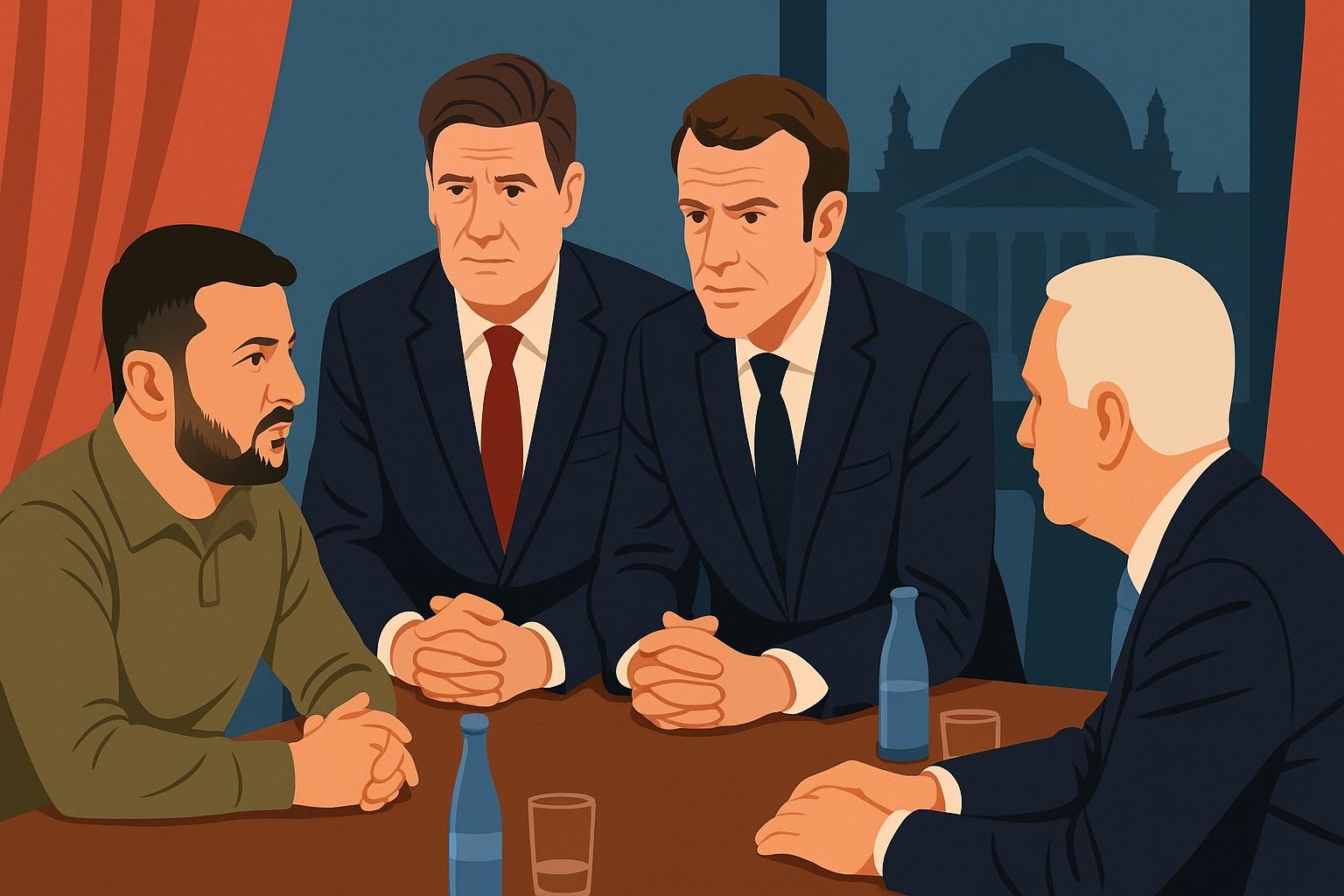
European diplomacy has entered a critical phase as leaders including British Prime Minister Keir Starmer and French President Emmanuel Macron gather in Berlin alongside Ukrainian President Volodymyr Zelensky and senior American officials. The talks represent one of the most serious attempts in months to break the deadlock in the war in Ukraine and reach at least a framework agreement before the end of the year.
The Berlin meetings come amid growing fatigue across Europe over the prolonged conflict, mounting economic pressures, and rising political divisions within EU member states. With winter deepening and military operations becoming more complex, European capitals see the coming weeks as a narrow window to test whether diplomacy can succeed where battlefield momentum has stalled.
At the center of discussions are proposals for a temporary ceasefire, security guarantees for Ukraine, and mechanisms to prevent renewed escalation. While Kyiv continues to insist on protecting its sovereignty and territorial integrity, Western officials are exploring formulas that could reduce active fighting without forcing immediate final-status concessions. American representatives are reportedly focused on aligning European positions and ensuring any deal maintains transatlantic unity.
Berlin’s role as host is symbolically significant. Germany has positioned itself as a bridge between more hawkish and more cautious European governments, seeking to balance military support for Ukraine with diplomatic engagement. French and British leaders are expected to push for a coordinated European voice, warning that a fragmented approach would weaken leverage over Moscow and complicate any peace process.
Despite the high-level engagement, expectations remain cautious. Deep disagreements persist over territory, security arrangements, and the sequencing of negotiations. European officials privately acknowledge that a comprehensive peace deal before Christmas is unlikely, but emphasize that even partial progress—such as confidence-building measures or humanitarian arrangements—could reduce civilian suffering and open the door to broader talks in early 2026.
As the meetings continue, the outcome will be closely watched not only in Kyiv and Moscow, but across Europe, where the war has reshaped security thinking, energy policy, and geopolitical priorities. Whether Berlin marks the beginning of a breakthrough or simply another chapter in prolonged diplomacy, it underscores a shared realization among Western leaders: the cost of indefinite war is becoming increasingly difficult to sustain.