


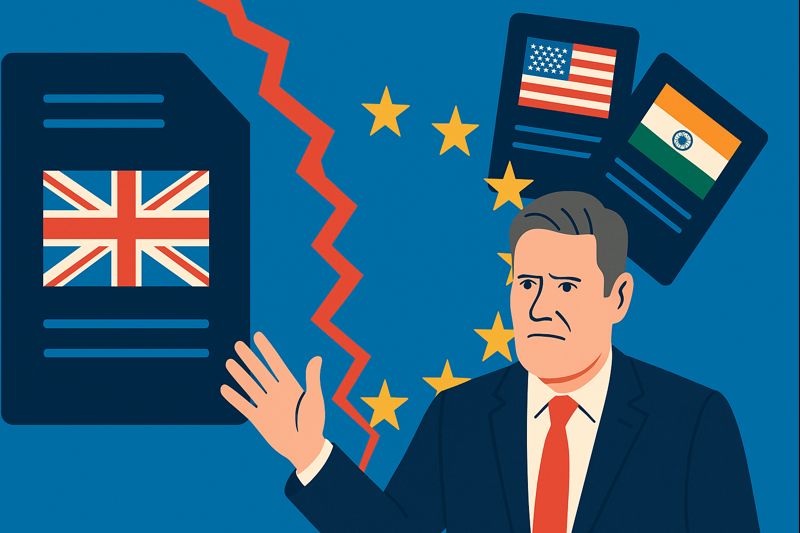
Prime Minister Sir Keir Starmer has issued his clearest warning yet against any move for the UK to re-enter the European Union’s customs union, arguing that such a step would undermine key post-Brexit trade agreements — particularly those recently struck with the United States and India.
Starmer, speaking in the House of Commons, said that while he seeks a closer and more stable trading relationship with the EU, reversing Brexit arrangements by rejoining a customs union would “unravel” carefully negotiated trade deals that benefit major British industries, including automotive manufacturing and pharmaceuticals.
According to the prime minister, the agreement with Washington has been especially advantageous for Jaguar Land Rover, supporting jobs and investment at home. “Having now done significant trade deals with other countries, including the US and India, … it is not sensible to unravel what is effectively the best deal with the US that any country has got,” he told MPs.
Balancing EU Relations With Post-Brexit Autonomy
The Labour government is currently pursuing targeted negotiations with Brussels aimed at easing trade frictions in areas such as food safety, energy cooperation, and a new youth mobility scheme. Starmer stressed that these discussions are a priority, and reopening the broader question of a customs union would complicate efforts already underway.
European relations minister Nick Thomas-Symonds held talks this week with European Commission vice president Maroš Šefčovič. Although both sides described the meeting as “productive,” notable differences remain — particularly over proposals for a youth mobility plan that would allow 18- to 30-year-olds to live, study, and work across the UK and EU.
The UK insists that any scheme must include a cap on participant numbers and rejects the EU’s demand for British universities to charge EU students the same “home fee” rates as domestic students.
These tensions come after last month’s breakdown in negotiations over the UK’s financial contribution to a €140bn EU defence fund.
Customs Union Debate Divides Views in Westminster
While some Labour MPs and opposition leaders — including Liberal Democrat leader Sir Ed Davey — argue that joining a customs union is the most effective route to restoring strong economic growth, trade analysts warn that doing so would eliminate the UK’s ability to set independent tariffs.
Joël Reland of the UK in a Changing Europe think-tank explained that customs union membership would require the UK to apply the EU’s tariff schedule. This would force London to abandon tariff reductions offered in bilateral agreements with partners such as Australia, India, and the US.
“If the EU were to impose major tariffs on US goods, the UK would have to follow suit. The era of using lower tariff rates to draw concessions from the White House would be over,” Reland said.
Ongoing Issues With the EU
Tensions continue to surface in other policy areas. A leaked EU proposal for a “youth experience scheme” revealed significant disagreements, raising concerns that the dispute could hinder progress on a veterinary agreement to streamline border checks, as well as plans to reconnect UK and EU carbon pricing systems.
Despite the challenges, the government maintains that it wants a “closer relationship than the one we have now” with the EU — but not at the expense of the UK’s post-Brexit trade independence.