

French defence and technology company Thales has called for an international framework to govern the development of artificial intelligence, warning that technical safeguards alone may not be sufficient to keep increasingly powerful systems under human control.
Thales chief executive Patrice Caine said governments must play a central role in establishing clear rules for the development and use of AI. He argued that maintaining control over the technology is primarily a question of governance rather than simply an engineering challenge.
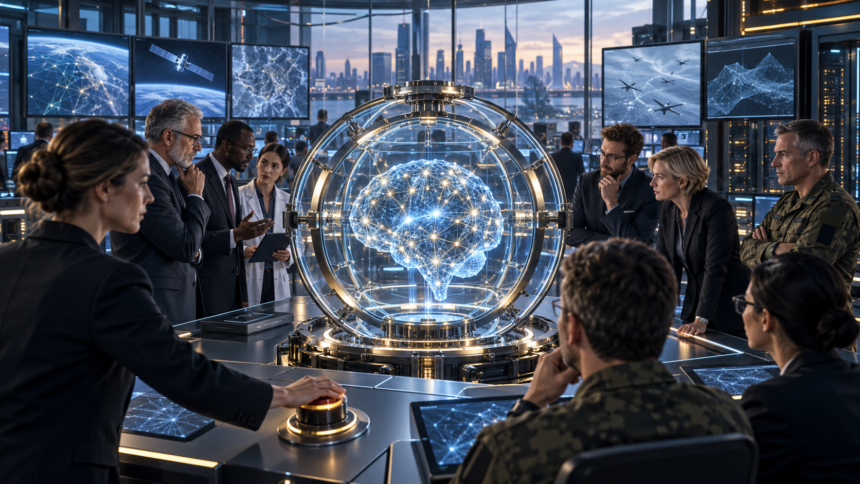
The company issued the warning while presenting new military technologies that use artificial intelligence to process information collected by drones, satellites, sensors, and other battlefield systems. Such tools can help commanders identify threats, interpret large volumes of data, and make decisions more quickly.
However, the expanding military use of AI has raised concerns about accountability, human oversight, and the possibility of automated systems making or influencing life-and-death decisions. Thales is therefore calling for common international standards defining how these technologies should be tested, supervised, and deployed.
The debate is also connected to Europe’s campaign for greater technological sovereignty. European governments and companies are seeking to reduce their dependence on American and Chinese technology providers, particularly in strategically sensitive sectors such as defence, artificial intelligence, cloud computing, and data infrastructure.
Concerns have intensified following NATO’s adoption of the Maven Smart System developed by US-based Palantir Technologies. Although the platform offers advanced data-analysis capabilities, its use has prompted questions about Europe’s reliance on foreign companies for critical military technologies.
Thales is developing its own AI-powered defence systems, including Hexaforce, as part of an effort to provide European armed forces with alternatives that can be operated under European security and data-governance standards.
French officials have also backed the push for greater technological independence. They argue that Europe must develop its own AI models, computing infrastructure, and defence platforms to maintain control over sensitive information and avoid strategic vulnerability.
Establishing a global regulatory framework will be difficult, particularly as major powers compete for technological and military advantage. Governments may be reluctant to accept restrictions that could slow innovation or place their defence industries at a disadvantage.
Nevertheless, Thales maintains that international cooperation is necessary to establish minimum safeguards and preserve meaningful human control. The company’s intervention highlights the growing tension between the rapid adoption of military AI and the slower development of rules governing how it should be used.