


By using this site, you agree to the Privacy Policy and Terms of Use.
Accept
Euro Post.Euro Post.
Notification Show More
Aa
  • My Europe
    • Europe News
    • Social Issues
    • Immigration
    • EU Policies
    • EU Updates
  • World
    • Africa
    • Global Conflicts
    • Human Rights
    • Middle East
    • Latin America
    • Ukraine Crisis:
  • Business
    BusinessShow More
    Lamborghini Unleashes the Temerario: A Hybrid Supercar Poised to Surpass the Huracán
    July 26, 2025
    Is Waze Nearing the End of the Road? Google Maps Growth Raises Questions About the Future of the Navigation App
    July 26, 2025
    Germany Secures Fourth Conviction in €195 Million EU-Wide VAT Fraud Case Tied to Covid Mask Scam
    July 25, 2025
    AstraZeneca Commits $50 Billion Investment in U.S. Amid Tariff Pressures
    July 23, 2025
    ASML Shares Fall as Trump-Era Tariff Fears Cloud 2026 Growth Outlook
    July 17, 2025
  • Sport
  • Travel
  • Culture
    • Art/Design
    • Literature
    • Music
    • Film – TV
    • Fashion
Reading: European Banks Push for Easier Cross-Border Operations
Share
Aa
Euro Post.Euro Post.
  • My Europe
  • World
  • Business
  • Sport
  • Travel
  • Culture
Search
  • My Europe
    • Europe News
    • Social Issues
    • Immigration
    • EU Policies
    • EU Updates
  • World
    • Africa
    • Global Conflicts
    • Human Rights
    • Middle East
    • Latin America
    • Ukraine Crisis:
  • Business
  • Sport
  • Travel
  • Culture
    • Art/Design
    • Literature
    • Music
    • Film – TV
    • Fashion
Follow US
  • Advertise
© 2021 Euro Post Agency.com. All Rights Reserved.
Euro Post. > Blog > My Europe > Europe News > European Banks Push for Easier Cross-Border Operations
Europe News

European Banks Push for Easier Cross-Border Operations

World News
By World News Published September 2, 2025
Share

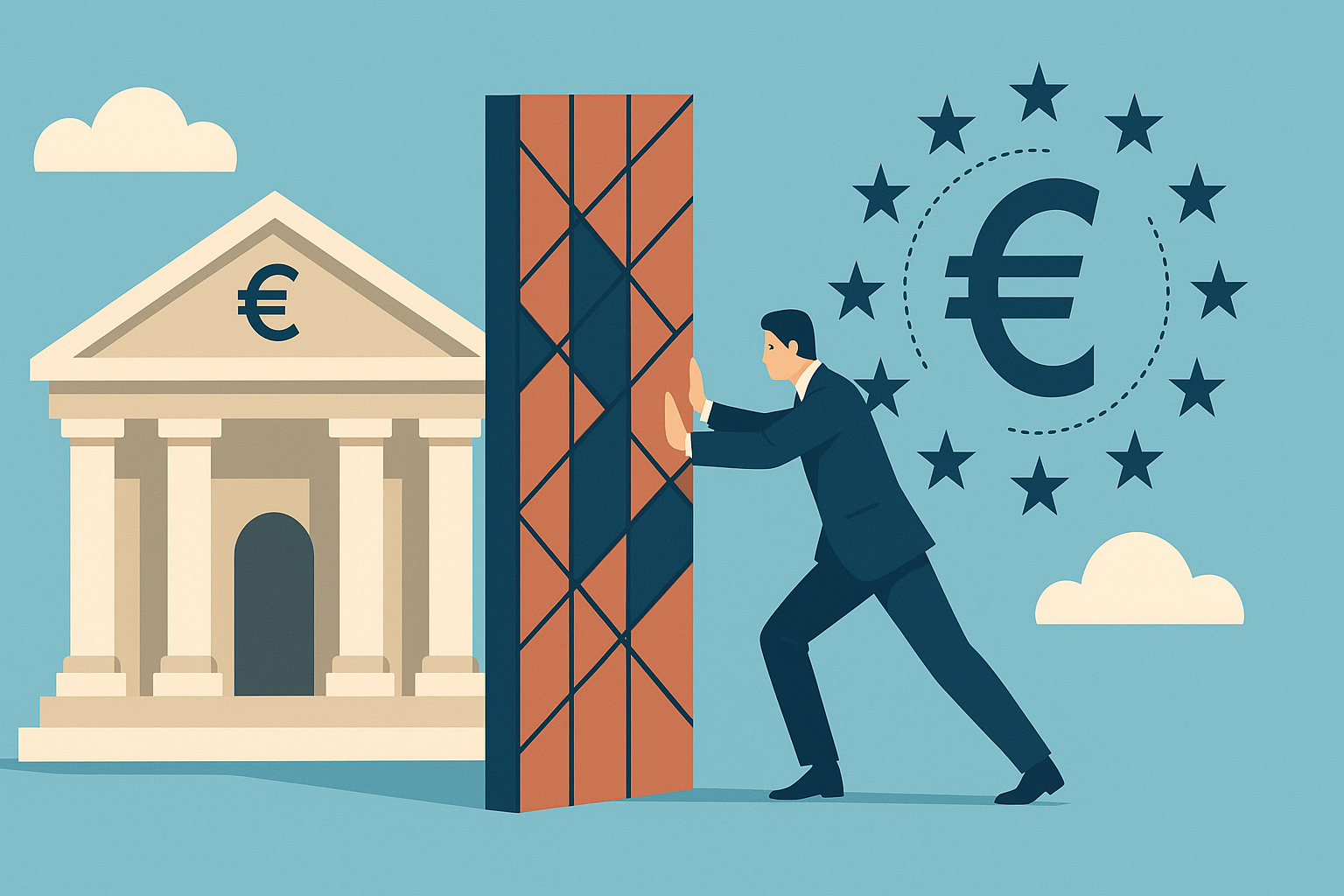
European banks are intensifying their calls for regulators to dismantle barriers that hinder cross-border banking services within the European Union, warning that these restrictions are leaving them at a disadvantage compared to their larger U.S. rivals.

Contents
Fragmented System vs. U.S. ModelRising Pressure Amid Global CompetitionMergers and Red TapeRegulatory Burdens

In a report published by the Association for Financial Markets in Europe (AFME), top lenders criticized regulators for locking away hundreds of billions of euros in capital and liquidity behind national barriers, delaying merger approvals, and failing to harmonize EU-wide rules.

Fragmented System vs. U.S. Model

“In theory, a bank should be able to collect deposits in Germany and lend them in Italy, much like how deposits in Kansas can support loans in California. In practice, national restrictions make this impossible,” noted a senior executive at a major European bank.

Adam Farkas, AFME’s chief executive, said the current fragmented approach is undermining profitability for banks operating across the banking union. He stressed that easing these restrictions would be “transformational in terms of economic efficiency” and essential for boosting financial stability and growth across the EU.

Rising Pressure Amid Global Competition

The renewed lobbying effort comes as U.S. and U.K. regulators adopt more bank-friendly approaches under political pressure to cut red tape. European banks fear being left behind if the EU does not act with similar urgency.

Efforts to complete the EU’s banking union have stalled for years over political disputes, particularly on a pan-European deposit insurance scheme. However, AFME argued that significant improvements could still be made without it, pointing to large sums of trapped resources — an estimated €225bn in capital and €250bn in liquidity.

Mergers and Red Tape

Cross-border mergers have also been heavily constrained. The AFME report highlighted that mergers and acquisitions between EU banks now take an average of 285 days to complete — far longer than the 219 days in the U.S., 173 days in the U.K., or 85 days in Switzerland.

Although there have been signs of renewed activity, such as France’s BPCE making a €6.4bn bid for Portugal’s Novo Banco earlier this year, political resistance often derails deals. For example, Italy’s UniCredit faced opposition over its investment in Germany’s Commerzbank.

Despite a small rise in Eurozone bank mergers last year, the overall number remains close to its lowest in three decades. The AFME warned that once Eurozone banks grow beyond €451bn in total assets, they face negative synergies, as administrative costs rise faster than economies of scale. This makes it harder for EU lenders to match the size and profitability of their U.S. counterparts.

Regulatory Burdens

The group also criticized the EU’s tougher requirements on MREL — the minimum amount of debt banks must issue to absorb losses in a crisis — which are stricter than those in the U.S. and U.K.

To strengthen efficiency and competitiveness, AFME urged authorities to:

  • Introduce waivers to release trapped capital and liquidity.
  • Simplify national macroprudential buffers.
  • Streamline merger approvals across borders.

As one senior banker put it: “If you can’t move funds across borders, what is the point of expanding cross-border?”


You Might Also Like

French authorities have announced the continuation of heightened security alert levels across several major cities as the country enters the busy summer tourism and events season.

Spanish Prime Minister Pedro Sánchez continues to face growing political pressure as legal investigations involving several of his close associates remain in the public spotlight, fueling intense debate across Spain’s political landscape.

Attention across Europe is firmly focused on the final round of the FIFA World Cup 2026 group stage, where several European national teams are fighting to secure qualification for the Round of 32 in one of the tournament’s most decisive phases.

London’s police are moving forward with plans to expand the use of drones and facial recognition technology as part of broader efforts to strengthen public security and improve crime prevention across the British capital.

Germany has recorded a noticeable increase in applications to join its armed forces, reflecting growing public interest as the government moves forward with plans to strengthen the country’s military capabilities in response to evolving security challenges across Europe.

World News September 2, 2025 September 2, 2025
Share This Article
Facebook Twitter Whatsapp Whatsapp Email Print
What do you think?
Love0
Sad0
Angry0
Dead0
Previous Article Ukrainian Politician Andriy Parubiy Assassinated in Lviv
Next Article Rafael Nadal’s Aristocratic Title Sparks Debate on the Future of Spain’s Nobility

Stay Connected

16k Like
85k Follow
45.6k Subscribe
Telegram Follow
- Advertisement -

Latest News

French authorities have announced the continuation of heightened security alert levels across several major cities as the country enters the busy summer tourism and events season.
Europe News
Spanish Prime Minister Pedro Sánchez continues to face growing political pressure as legal investigations involving several of his close associates remain in the public spotlight, fueling intense debate across Spain’s political landscape.
Europe News
Attention across Europe is firmly focused on the final round of the FIFA World Cup 2026 group stage, where several European national teams are fighting to secure qualification for the Round of 32 in one of the tournament’s most decisive phases.
Europe News
London’s police are moving forward with plans to expand the use of drones and facial recognition technology as part of broader efforts to strengthen public security and improve crime prevention across the British capital.
Europe News
Loading

Stay Informed,Europ’s Vioce Unfolded

Sign Up for Our Newsletter

Subscribe to our newsletter to get our newest articles instantly!

Loading
© 2022 Euro Post Agency. All Rights Reserved.